
Startup banking used to mean branch visits, paperwork, and fees nobody could fully explain. Mercury built its whole pitch around fixing that, a digital first business account with no monthly fee, built specifically for founders who live in a browser tab, not a lobby. The real question for a business owner isn’t whether Mercury looks slick. It’s whether the underlying banking, the fees, the integrations, the support, actually justifies moving your operating cash there. This review breaks that down.
Explore Mercury Business Banking
Key Benefits of Mercury
Built specifically for startups and growing businesses
Powerful integrations with modern accounting software platforms
No monthly maintenance fees on core banking
Streamlined domestic and international business payment transfers
Scalable banking tools built for growing finance teams
About Mercury
Company Overview
Mercury launched in the late 2010s, founded by Immad Akhund alongside a small founding team, aiming to fix what founders kept calling clunky, outdated business banking. It’s a fintech company, worth saying plainly, not a chartered bank itself. Actual banking services run through partner banks, Choice Financial Group and Column N.A., both FDIC insured. Mercury has grown to serve well over 100,000 businesses at this point.
Businesses Mercury Serves Best
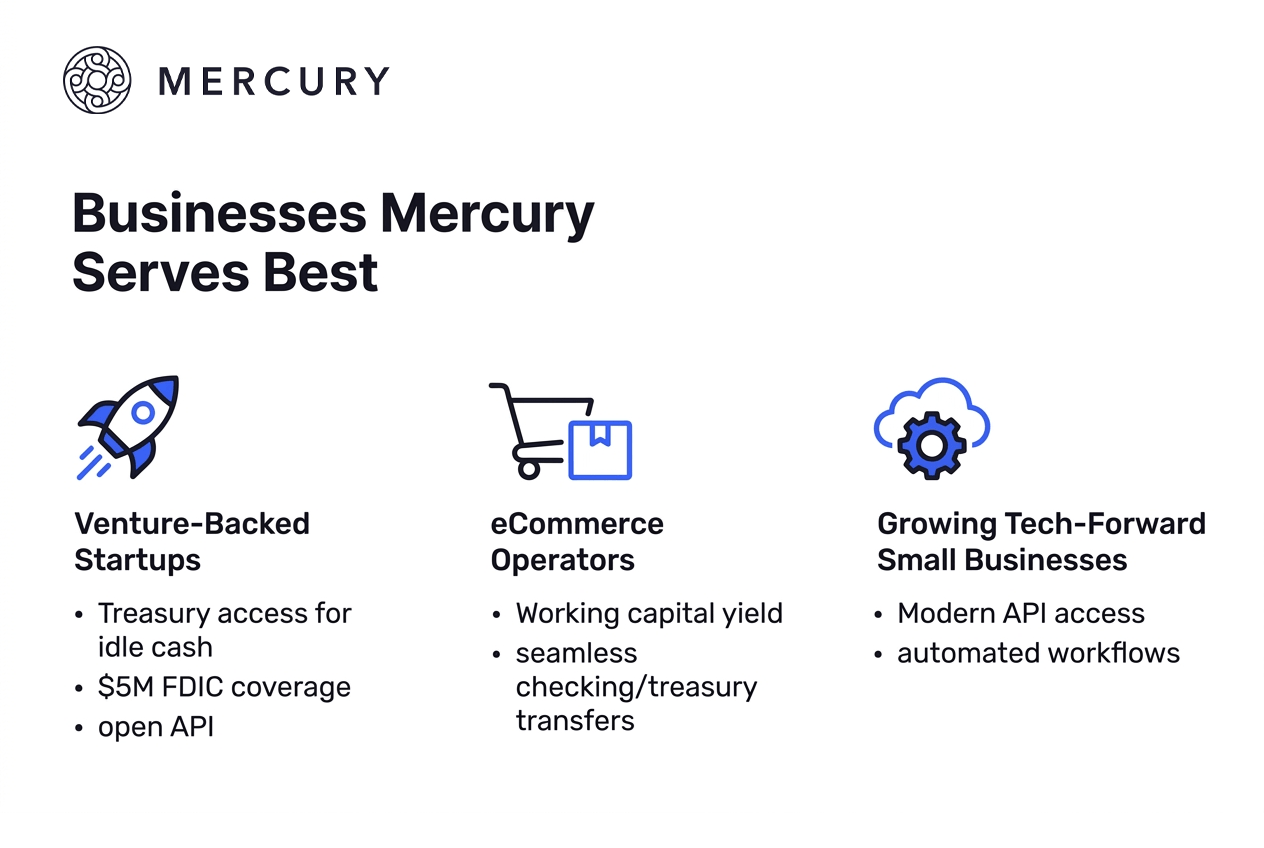
Venture backed startups show up constantly as the core user base, alongside ecommerce operators and small to medium businesses that want a modern, API accessible account rather than a branch relationship.
Banking Features & Pricing
Business Checking & Treasury Accounts
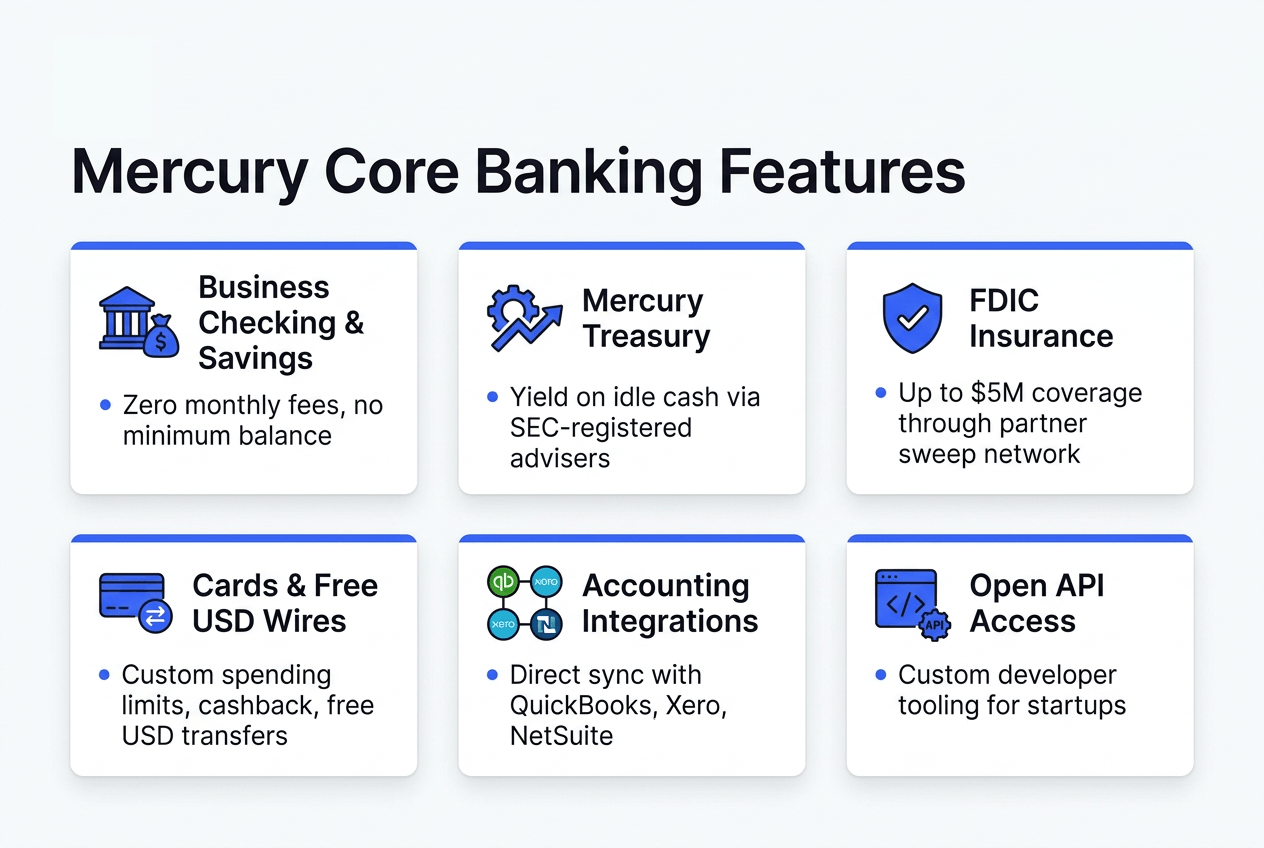
The core account includes business checking and a high yield savings option, with rates that float alongside the Federal Funds Rate rather than sitting fixed. Businesses holding $250,000 or more can access Mercury Treasury too, a way to put idle cash into low risk, liquid funds instead of letting it sit flat, offered through SEC-registered adviser Mercury Advisory, LLC. Treasury accounts carry a separate annual advisory fee of 0.15%–0.60%, charged monthly based on total Mercury balances.
Pricing & Account Fees
Zero monthly fee on the base tier, no minimum balance requirement either. Mercury Plus and Mercury Pro sit above that, Pro running around $350 a month, adding dedicated support, more integrations, and stronger bill pay capabilities. Whether that upgrade is worth it really depends on how much of Mercury’s automation layer your team actually uses day to day.
Cards, Payments & Transfers
Debit and credit cards come with customizable spending limits and category controls, plus cashback on the credit side. Domestic and international USD wires come free, which stands out against traditional banks charging $20 to $35 per wire. Non-USD transfers carry a small conversion fee, worth factoring in if you are running international vendor payments regularly.
Compare Mercury Banking Features
Digital Banking Experience
Account Opening Process
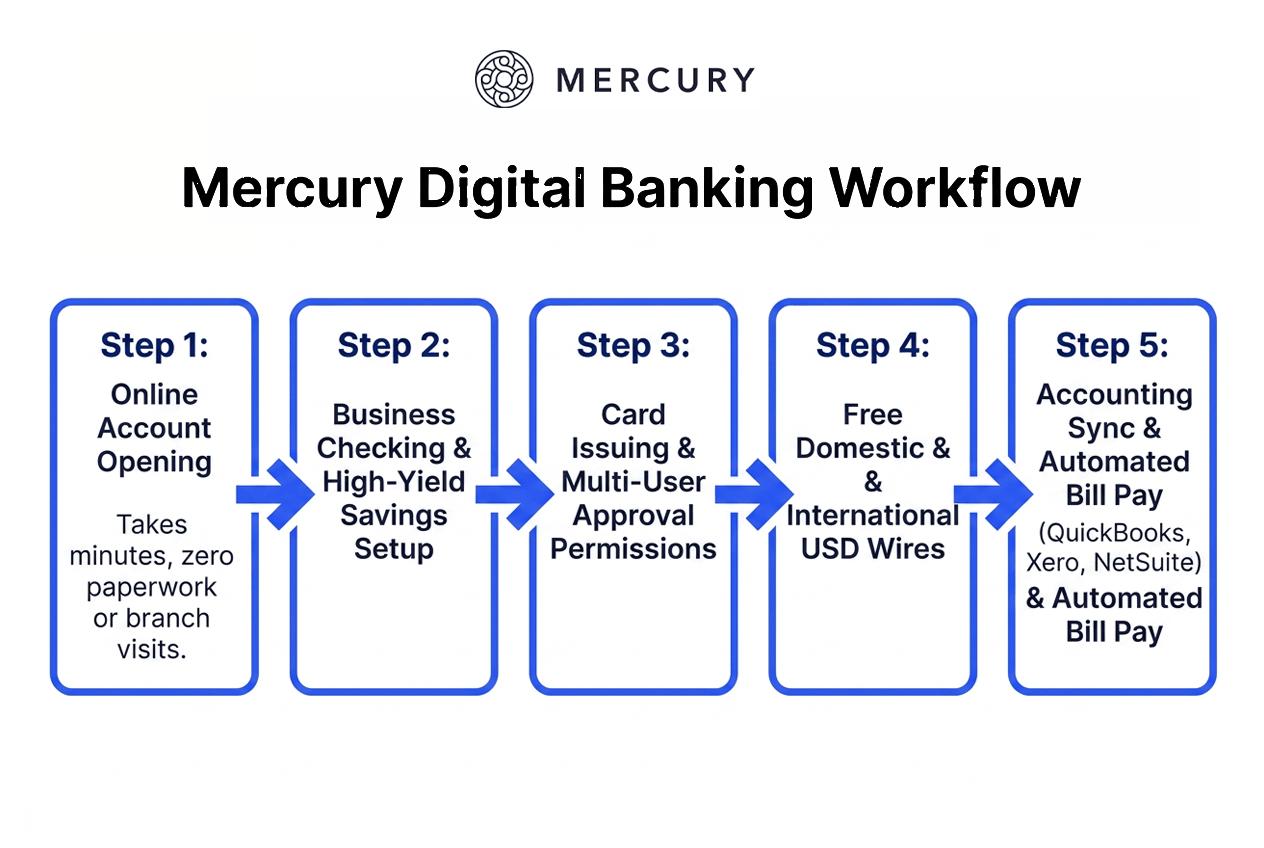
Opening an account runs entirely online, typically taking minutes rather than the days a traditional bank visit might require. No branch trip, no paper forms to mail in.
Online Dashboard & Mobile Access
The dashboard gets consistently good marks for being clean and fast, genuinely usable without a finance background. Mobile access covers the basics well, transfers, card management, balance checks, nothing feels bolted on as an afterthought.
Multi-User Permissions
Approval workflows let a business control who can authorize different payment types, rather than just handing out account access broadly. Slack integration even lets teams approve or decline payments without leaving a channel they are already working in.
Integrations & Financial Tools
Accounting Software Integrations
QuickBooks Online, Xero, and NetSuite all connect directly, syncing transaction data instead of requiring manual exports. For a finance team already living in one of those tools, this cuts real reconciliation time.
Automation & Workflow Tools
Bill pay, invoicing, and reimbursement tools come built in, organized by due date and approval status rather than living in a separate spreadsheet somewhere. Automating this layer is really where Mercury earns its keep for a growing operations team.
API & Startup Ecosystem
API access lets more technical teams build custom integrations Mercury doesn’t offer out of the box, a genuine differentiator for startups with engineering resources to spare.
Customer Support & Security
Support Channels
Support runs primarily through in-app messaging, with dedicated phone access reserved for higher tiers. Free tier users don’t get phone support, worth knowing upfront if that matters to you.
Security & Account Protection
Two factor authentication, detailed activity logs, and team level permission settings all come standard. FDIC insurance runs up to $5 million through Mercury’s partner bank sweep network, well beyond the usual $250,000 ceiling most business accounts carry.
Customer Feedback Trends
Sentiment leans positive overall, plenty of founders describe it as the first bank that doesn’t frustrate them. But a real pattern shows up across BBB complaints and Trustpilot reviews too, accounts occasionally getting closed without a clear explanation, sometimes with funds held for weeks. Worth taking seriously rather than dismissing, since the lack of physical branches means resolving that kind of issue in person just isn’t an option.
Best Fit for Different Businesses
Startups & SaaS Companies
This is genuinely where Mercury shines, venture backed companies needing treasury management, high FDIC coverage on large raises, and API access for custom financial tooling.
eCommerce Businesses
Businesses holding meaningful working capital between inventory cycles benefit from the high yield savings option and the ability to move cash efficiently between checking and treasury.
Growing Small Businesses
Smaller, service based businesses can use Mercury fine, though some may find the platform’s depth exceeds what a simpler operation actually needs day to day.
Pros and Cons
Mercury earns real credit for fee structure and integrations, though a few tradeoffs matter depending on your business type.
Pros
- No monthly fees or minimum balance on the core account
- FDIC coverage up to $5 million through partner bank sweep networks
- Free domestic and international USD wires
- Deep accounting integrations and API access for custom tooling
Cons
- No phone support on the free tier
- Account closures without clear explanation show up as a recurring complaint
- US only, no cash deposit option
- Treasury accounts carry a separate advisory fee. Investments are not FDIC-insured.
Mercury vs Relay
Both dominate comparisons in the startup banking space, though they actually serve fairly different business profiles.
| Factor | Mercury | Relay | |
|---|---|---|---|
| Account Features | API access, higher FDIC coverage through partner banks |
|
|
| Software integrations | QuickBooks, Xero, NetSuite, plus open API | QuickBooks and Xero, narrower scope | |
| Pricing | Free core tier, Pro around $350 a month | Freemium, paid tiers for added accounts and features | |
| Best business type | Venture backed startups, tech forward operators | Small, service based businesses using Profit First style budgeting |
Neither wins outright here. Mercury tends to fit better for funded startups that need treasury tools and deeper technical integration. Relay tends to suit smaller, cash flow focused businesses that want simple account segmentation without much added complexity.
Is Mercury Worth It?
Worth it if your business needs FDIC coverage beyond the standard limit, values deep accounting and API integrations, or is holding enough cash to benefit from Mercury Treasury. Less compelling if you need in person banking, cash deposits, or phone support without paying for a higher tier. For most digitally operating startups and growing businesses, the value case is genuinely strong.
Frequently Asked Questions
Is Mercury good for startups?
Yes, it’s arguably built specifically for that audience, with treasury tools and integrations most traditional banks don’t offer.
Does Mercury charge monthly fees?
Not on the core account, though Plus and Pro tiers carry fees for added features and support.
Is Mercury FDIC insured?
Yes, through partner banks Choice Financial Group and Column N.A., with coverage up to $5 million via a sweep network.
Can small businesses use Mercury?
Yes, though smaller or simpler operations may find some of the platform’s depth unnecessary for their day to day needs.
Is Mercury better than Relay?
Depending on the business, Mercury wins on treasury tools and FDIC coverage, Relay wins on simple multi account cash flow structure.
Final Verdict
Mercury holds up well for venture backed startups and tech forward businesses that want a modern account without monthly fees eating into the runway. The FDIC coverage, free wires, and integration depth genuinely solve real operational problems for that audience.
Traditional banks may still make more sense for businesses needing cash deposits or in person service, and the recurring account closure complaints are worth weighing seriously before moving critical operating funds over entirely. For most digitally native businesses though, Mercury represents a strong long term banking decision rather than just a trendy alternative.
Open a Mercury Business Account