Phones, hotspots, office internet. Every growing business hits this wall eventually, and someone always ends up troubleshooting a carrier issue nobody has time for. T-Mobile Business says it fixes that whole mess, one account, wireless plans, fixed 5G internet, enterprise tools bundled together.
Does it actually beat Verizon Business for your team though? That’s the real question. Not whether the ads sound good. Plans, coverage, pricing, exactly where T-Mobile pulls ahead and where it falls short, all of that gets covered here.
Explore T-Mobile Business Solutions
Key Benefits of T-Mobile Business
- Flexible wireless solutions for businesses of all sizes
- Nationwide 5G network supporting mobile workforces
- Business internet options for office connectivity
- Enterprise tools for managing devices and users
- Dedicated business support and account management
About T-Mobile Business
Company Overview
T-Mobile has spent years pushing its 5G buildout further than either major competitor, and that network now anchors its whole business offering. Beyond phone plans, the business arm covers fixed wireless internet, device management tools, and enterprise grade security features aimed at companies that have outgrown a handful of basic phone lines.
Who T-Mobile Business Is Best For
Small businesses wanting simple, affordable per line pricing fit well here. So do remote and hybrid teams needing reliable mobile data, and multi-location businesses that want the internet up and running fast without waiting on a wired install.
Business Plans & Pricing
Wireless Plans for Businesses
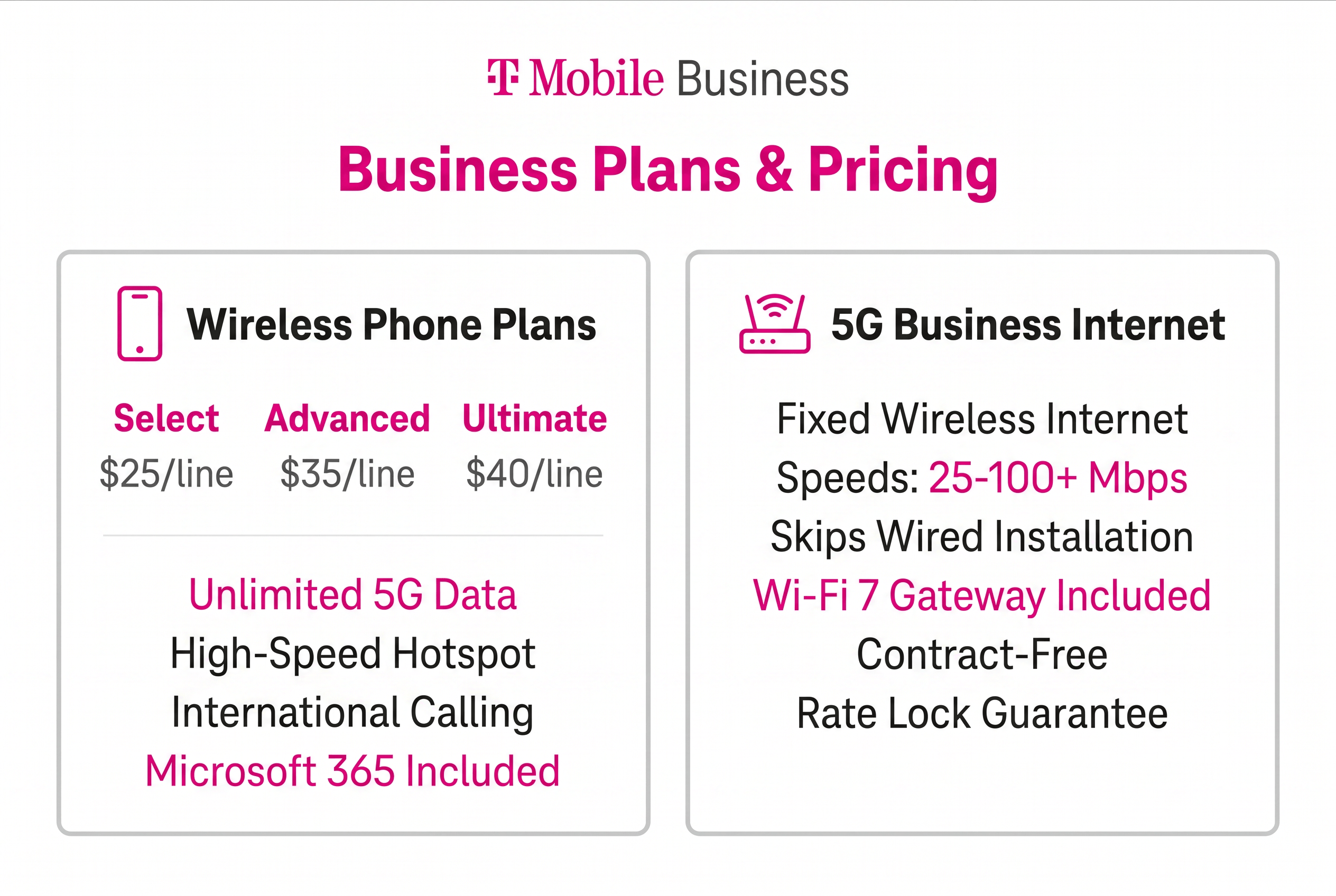
Three tiers make up T-Mobile’s current business phone lineup: CoreMobile, ProMobile, and SuperMobile. Quick note on the pricing below, it’s based on six lines with AutoPay turned on, since that’s the rate T-Mobile itself leads with. Activate more or fewer lines and the per-line number shifts around some.
Start cheap with CoreMobile. Twenty-one bucks a line gets you the basics, unlimited talk, unlimited text, 5G data that doesn’t throttle unexpectedly. Premium data caps at 50GB though, and the hotspot is thin, just 5GB. No Threat Protect security bundled in here either.
Step up to ProMobile and the number jumps to $34 a line. Worth it if hotspot matters to your team, this tier bumps that allowance all the way to 200GB, and premium data climbs to 200GB too. Threat Protect comes standard now, and streaming quality goes from plain HD up to 4K UHD.
SuperMobile sits at the top, $42 a line, and this is where the caps mostly disappear. Premium data goes fully unlimited, no ceiling at all. Hotspot climbs again to 300GB. Threat Protect’s included the same as ProMobile. Two things only SuperMobile gets though. T-Satellite connectivity for staying reachable outside normal coverage. A nationwide network slice meant to keep performance steady even when demand spikes.
A few things hold true across all three tiers. Five year price guarantee on the talk, text, and data portion specifically, taxes, fees, and any add-ons you tack on later aren’t covered by that lock. International calling and texting reaches 215+ countries no matter which tier you’re on. Canada and Mexico get unlimited talk and text plus up to 5GB of high-speed data too, standard on every plan.
Business Internet Solutions
Skips the wired install completely. Runs on the same 5G network as the phone plans do. Currently priced at $70 a month standalone, or $40 a month when bundled with an eligible business voice line, both backed by the same 5-year price guarantee on the internet rate itself. No annual contract. Real-world speeds vary by location and network congestion, same as any fixed wireless setup.
Devices & Equipment Options
A Wi-Fi 7 gateway comes included on current internet plans. Static IP upgrades are available separately for businesses that need a consistent network address rather than one that shifts periodically.
Compare T-Mobile Business Plans
Business Features & Enterprise Solutions
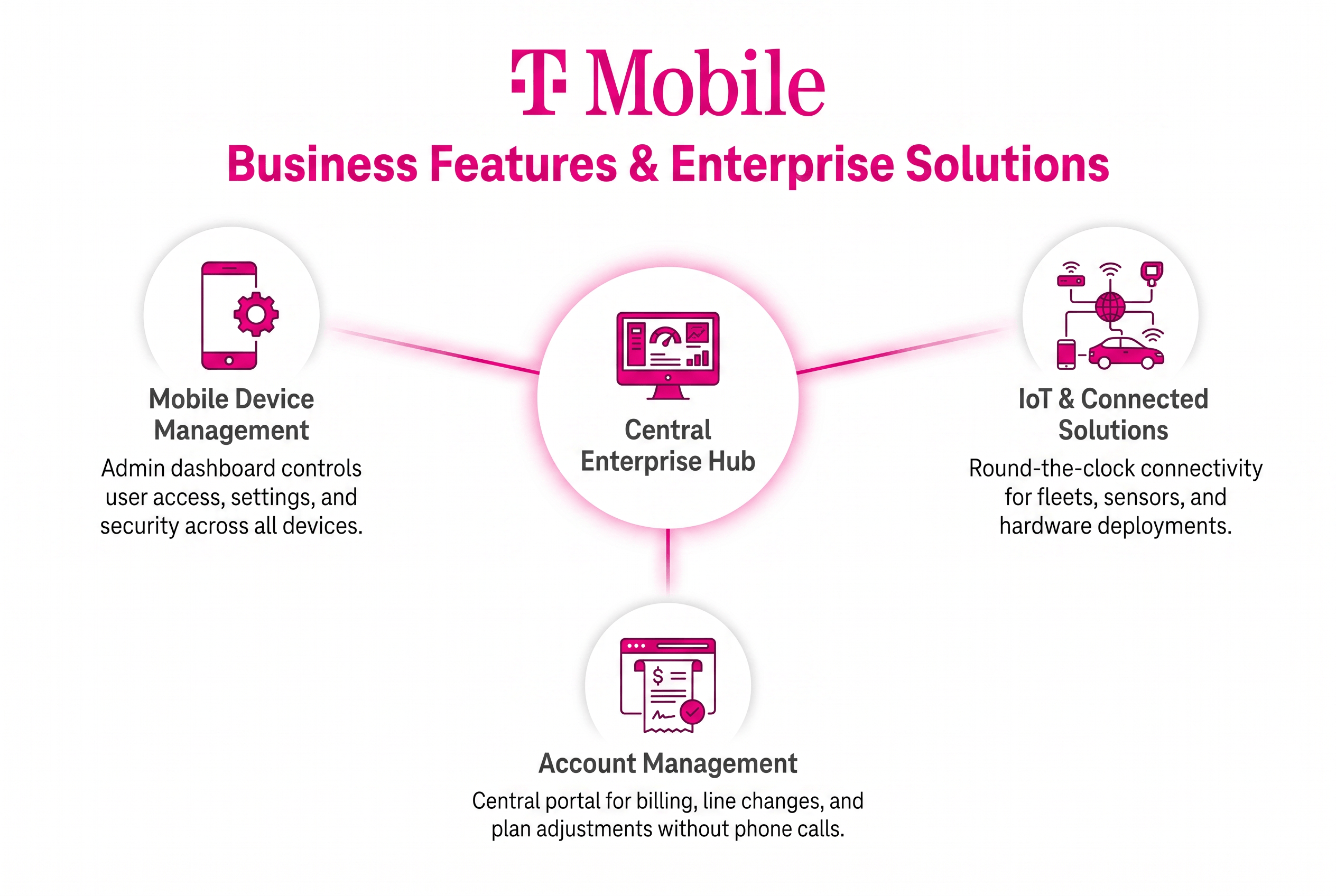
Mobile Device Management
Managing devices and users across a growing team gets easier here. An IT admin controls access and settings from one dashboard, no need to configure each phone by hand.
IoT & Connected Business Solutions
Fleets, sensors, other equipment that just needs to stay connected around the clock, T-Mobile’s network handles those deployments too, well beyond standard phone lines.
Business Account Management
Account management runs through a centralized portal, covering billing, line changes, and plan adjustments without needing a phone call for every routine task.
Network Performance & Coverage
5G Coverage
More geography covered here than either Verizon or AT&T manage with their own mid-band buildouts. Suburban and rural areas benefit most, that’s where mid-band signals actually decide whether speed stays consistent.
Reliability for Business Operations
Metro area performance tends to run fast, T-Mobile Business typically posts the quickest download speeds among the big three in urban settings. Rural coverage got a lot better too, in fairness, though Verizon keeps its edge in a handful of remote spots still.
Support for Remote & Hybrid Teams
Distributed teams working outside a normal office get real value from the hotspot data and steady 5G access here. Just depends on coverage actually holding up wherever your people happen to be working from.
Customer Support & Scalability
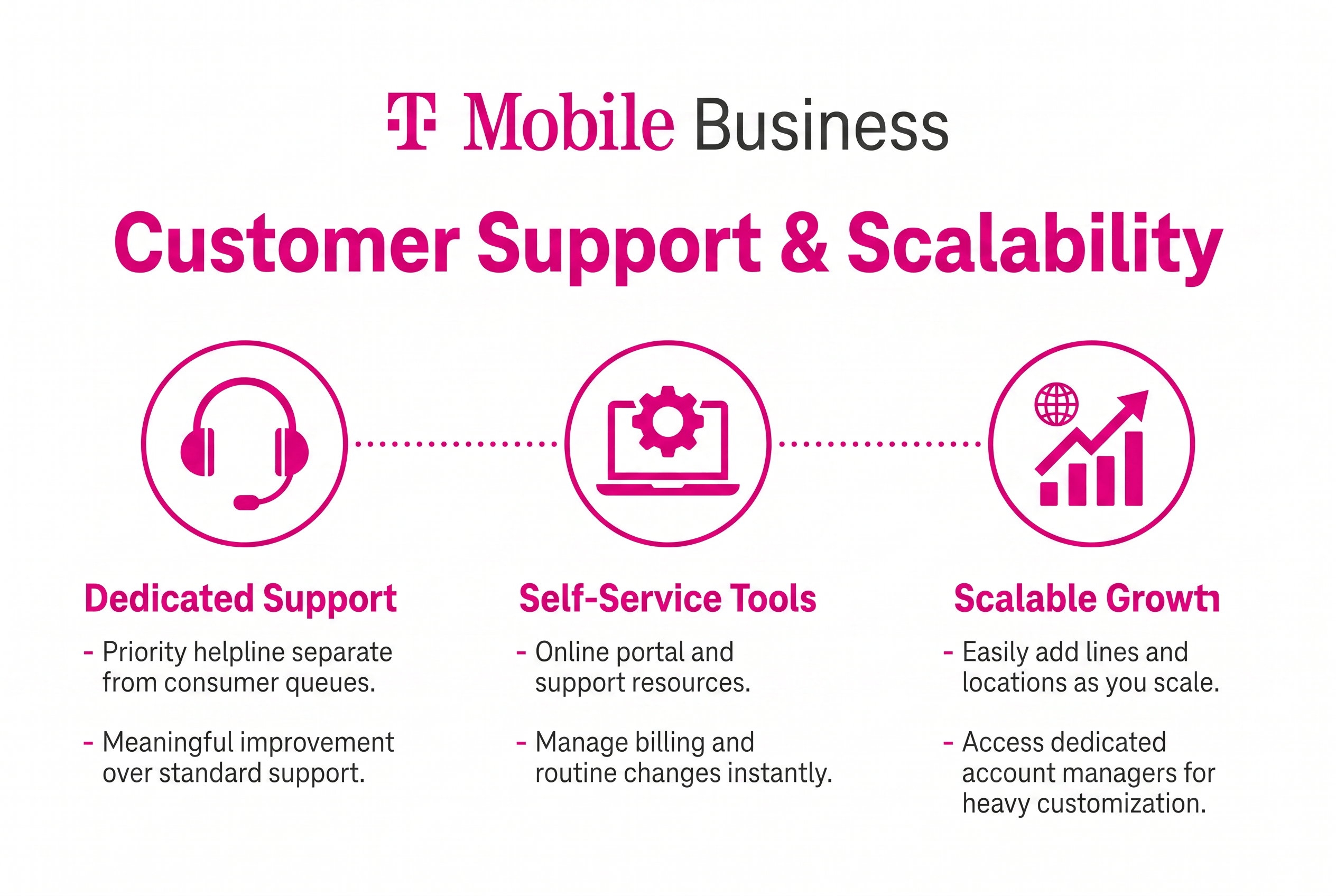
Business Customer Service
Dedicated business support exists separately from consumer service lines, generally a meaningful improvement over navigating a general customer service queue built for individual phone plans.
Support Resources
Online resources and account tools cover most routine needs without requiring a support call, useful for businesses that want to self-manage day to day changes.
Growing with Your Business
Adding lines or locations, plans scale fine for most of that, up to 12 lines purchasable online, with larger accounts handled through a business sales rep. Heavy customization is the exception though. That’s usually where the self-service dashboard runs out of road, and enterprise customers end up wanting a real person managing their account instead.
Pros and Cons
Network reach and pricing, that’s really where T-Mobile earns its credit. A few tradeoffs still matter depending on the kind of business you run.
| Pros | Cons |
|---|---|
| Per line pricing stays competitive across all three tiers | Fixed wireless speed shifts with location and how busy the tower is |
| Mid-band 5G reach is the biggest around, suburban and rural areas benefit most | Some remote regions still see Verizon pull ahead on coverage |
| Business internet skips the contract, price lock option included | Deeper customization often means stepping past self-service tools |
| SuperMobile tier includes T-Satellite and network slicing | Entry-tier CoreMobile skips Threat Protect security by default |
T-Mobile Business vs Verizon Business
Both carriers show up constantly in business wireless comparisons. Where your team actually operates ends up being the deciding factor more than anything else.
| Factor | T-Mobile Business | Verizon Business |
|---|---|---|
| Network coverage | Mid-band 5G leads here, metro speed especially fast | Reliability wins overall, remote and rural areas hold up better |
| Business plans | CoreMobile, ProMobile, SuperMobile: $21 to $42 a line (6-line pricing) | My Biz Plan flexes by feature, generally costs more at scale |
| Internet solutions | Fixed wireless 5G, $40-$70/mo, no contract, price lock included | 5G, LTE, and Fios fiber, some plans require a contract term |
| Enterprise features | Device management solid, IoT tools still growing | Security and customization run deeper, more mature overall |
Neither wins outright. T-Mobile tends to suit cost conscious businesses in metro and suburban areas wanting fast data without long contracts. Verizon tends to suit businesses in remote regions or those needing deeper enterprise customization who are willing to pay more for it.
Is T-Mobile Business Worth It?
Team mostly working out of metro or suburban areas? Want flexible pricing with no contract hanging over you, and solid mobile data without Verizon’s usual premium attached? That’s the target buyer here.
Operations leaning heavily on remote or rural coverage though, where Verizon still has the edge, or a need for deep enterprise customization past what self-service tools offer right now, that’s a weaker fit. Most small to mid sized businesses land in the first camp, and the value case for them is genuinely strong.
Frequently Asked Questions
Is T-Mobile Business good for small businesses?
Yes. Competitive per line pricing, no contract internet, a genuinely solid fit for smaller teams.
What business plans does T-Mobile offer?
Three wireless tiers, CoreMobile, ProMobile, and SuperMobile, running $21 to $42 a line at 6-line pricing, plus separate 5G business internet plans on top.
Does T-Mobile provide business internet?
Yes, fixed wireless 5G starting around $40 a month when bundled with an eligible voice line, no contracts, a 5-year price lock on the internet rate.
How does T-Mobile Business compare with Verizon Business?
Price and metro area speed usually go to T-Mobile. Rural reliability and enterprise depth usually go to Verizon instead.
Can T-Mobile Business scale with growing companies?
Yes, reasonably well, up to 12 lines online and more through a business rep, though very large enterprise customers may eventually need more dedicated account support than self-service tools can offer.
Final Verdict
Small and mid sized companies wanting competitive pricing, fast metro area data, and internet that skips a long installation process, T-Mobile Business holds up well for exactly that crowd. Remote or rural coverage is the real thing to weigh carefully, Verizon still edges ahead there.
Enterprise organizations with genuinely complex needs may eventually want more dedicated support than T-Mobile’s mostly self-service model offers today. But for most growing businesses working out of metro and suburban areas, this represents a genuinely strong value proposition worth serious consideration.
Visit T-Mobile Business's Official Website