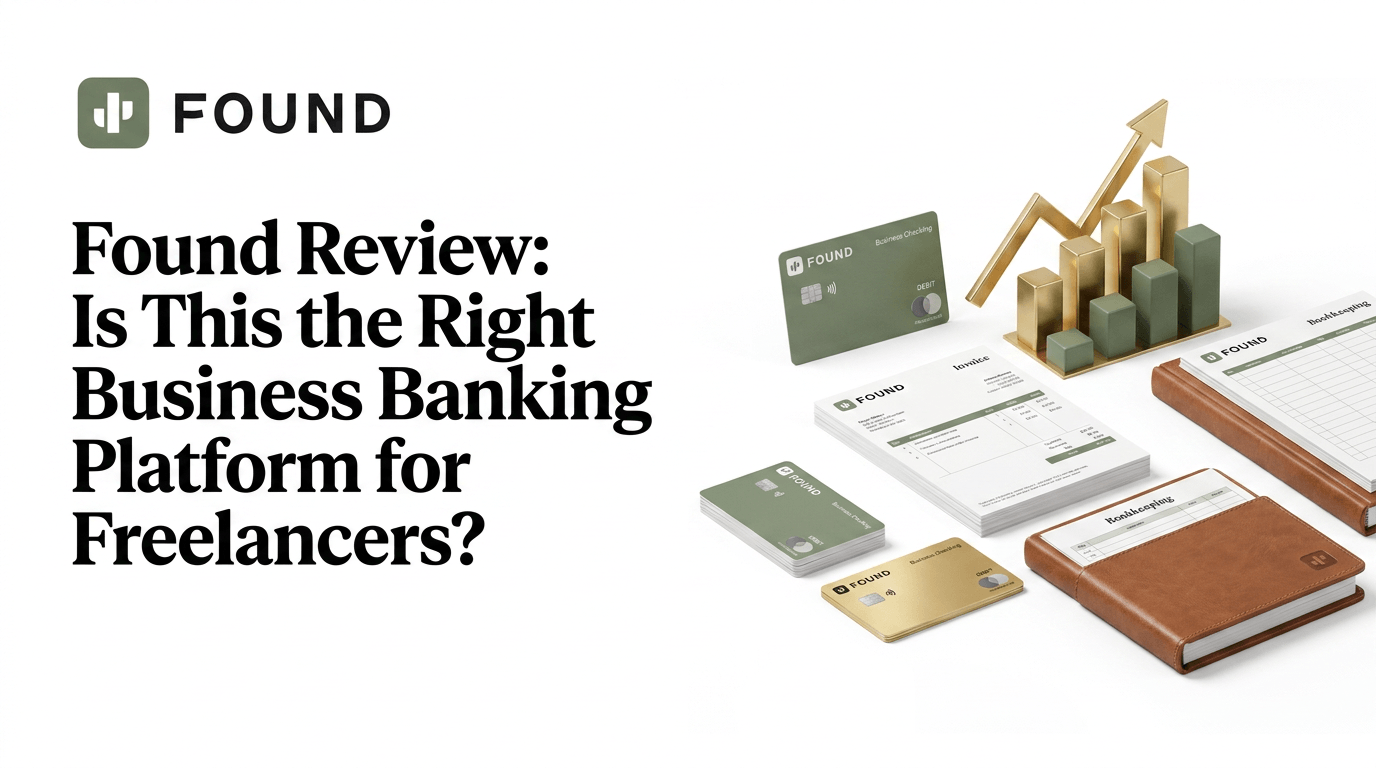
Most freelancers put off opening a business account for way too long, mixing personal and business spending until tax season turns into a mess. Found built its whole pitch around fixing exactly that. This Found review looks at whether bundling banking, bookkeeping, and tax estimates into one app actually holds up as a real business decision, not just a nice-sounding feature list. Worth reading before you decide where your business money lives.
Open a Found Business Account →
Key Benefits of Found
- Combines banking, bookkeeping, and taxes in one platform
- Built specifically for freelancers and independent professionals
- Tracks expenses automatically throughout your business activities
- Helps estimate quarterly tax obligations with automation
- No monthly fees for the standard business account Earn up to 2.50% APY on paid plans (the free plan does not earn APY)
About Found
Company Overview
Found is a fintech company, not a bank itself, it partners with Lead Bank to provide FDIC-insured checking accounts. No physical branches here, the whole thing runs through the app and the website, and the company operates out of California. That digital-only setup keeps overhead low, which is part of why the core account stays free.
Who Found Is Designed For
Sole proprietors, LLCs, and independent contractors make up most of the user base. If your business income comes from freelance work, consulting, or running a small operation solo, Found is built with exactly that structure in mind.
Banking Features & Pricing
Business Checking Account
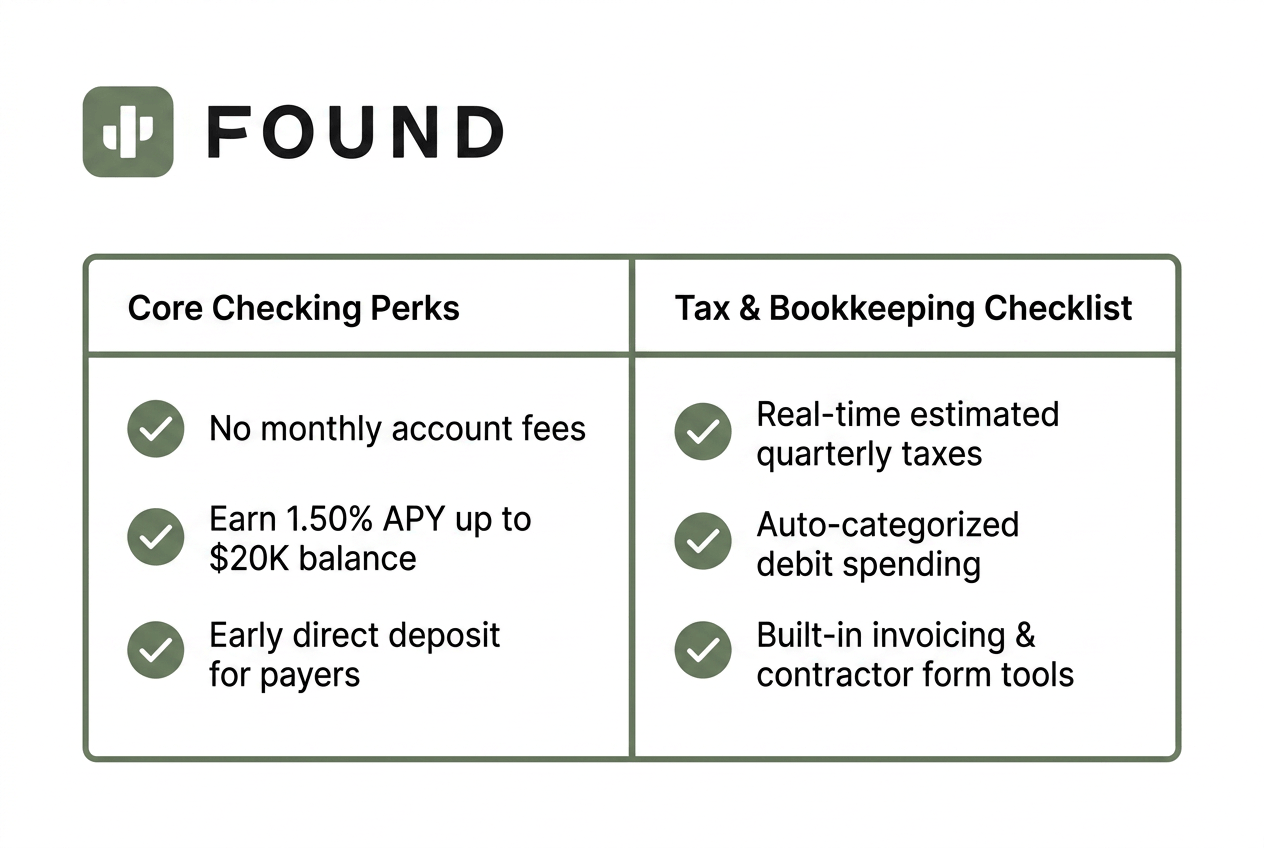
The core checking account comes with a Mastercard debit card, early direct deposit for qualifying payers, and no minimum balance requirement. The free plan does not earn APY. Interest starts on the paid plans, with Found Plus earning 1.50% APY on balances up to $20,000 and Found Pro earning up to 2.50% APY, covered in the pricing section below.
Bookkeeping & Tax Tools
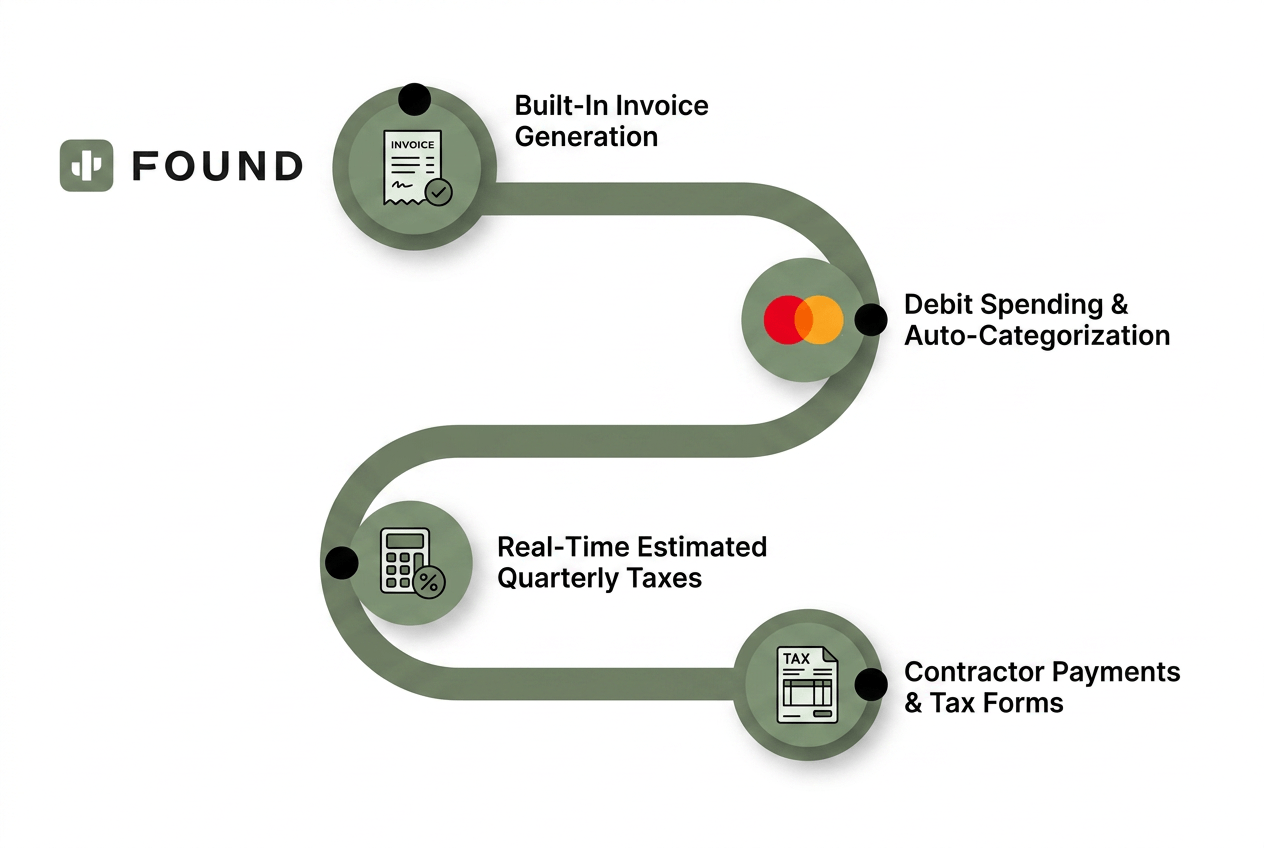
This is where Found business checking pulls ahead of a plain bank account. Expenses get categorized automatically off your debit card activity, and the app estimates quarterly tax obligations in real time. For freelancers who dread the quarterly tax math, that automation alone can justify switching.
Pricing & Subscription Options
Core features cost nothing, though the free plan does not earn the up to 2.50% APY. Found Plus runs $35 a month, or $315 billed annually, adding advanced tax tools and the ability to pay estimated taxes right from the app. It also earns 1.50% APY on balances up to $20,000. Found Pro goes further at $80 a month, aimed at businesses that need more robust reporting and priority support. Found Pro earns 2.50% APY with no balance cap, so it suits owners who keep larger balances in the account.
Compare Found Plans & Features →
Everyday Business Banking Experience
Mobile App & Account Management
The app handles pretty much everything day to day, checking balances, sending transfers, reviewing categorized expenses. Reviewers consistently describe the interface as clean, which matters a lot when you’re managing finances between client calls rather than during dedicated office hours.
Debit Card & Spending Controls
The Mastercard debit card supports multiple virtual cards, useful for separating spending by project or client. Controls are fairly basic though, don’t expect the granular spend limits you’d get from a platform built for larger teams.
Deposits & Payments
Direct deposit shows up early for qualifying payers, and ACH transfers run smoothly enough for routine business use. Found also handles contractor payments if you hire subcontractors, with tax form management built in.
Integrations & Financial Tools
Expense Tracking
Automatic categorization runs off your Found debit card, tagging purchases as they happen instead of leaving you to sort through statements later. Receipts can get attached and annotated too, which helps a lot at tax time.
Invoicing Features
Built-in invoicing lets you create recurring bills and schedule them out, your logo included. Clients have options for paying too, ACH works, so does Venmo, PayPal, Zelle as well. Card payments route through a Stripe integration, though heads up, that adds processing fees on top.
Accounting Workflow
Found’s integration ecosystem stays fairly narrow though, it doesn’t sync deeply with external accounting software the way some competitors do. If your business already runs on QuickBooks, Found ends up functioning more as a replacement than an add-on.
Customer Support & Security
Support Channels
Support runs through phone, email, in-app messaging too, but only during business hours, not around the clock. Priority handling kicks in for Found Plus and Pro subscribers, which actually matters a lot when you’re stuck with a time-sensitive account issue.
Account Security
Funds are FDIC-insured up to $250,000 per depositor through Lead Bank, standard coverage for this type of account. That’s lower than some competitors offering multi-bank sweep coverage, worth noting if you’re carrying larger balances.
User Feedback Trends
Feedback leans positive on the free tier specifically; freelancers appreciate the no-fee structure and built-in tax tools. Complaints tend to cluster around the paid tier’s price relative to what standalone bookkeeping software would cost. The interest rate can offset part of that cost if you hold a large balance, but only on the paid plans.
Best Fit for Different Businesses
Freelancers & Creators
This is Found’s strongest match. Solo freelancers get banking, invoicing, and tax estimates in one place without juggling separate subscriptions for each function.
Consultants & Agencies
Works well for solo consultants too, though agencies with employees may find the spending controls and reporting a bit thin once headcount grows past just one or two people.
Growing Small Businesses
Businesses scaling toward multiple employees will likely outgrow Found’s feature set. And once that happens, a platform with deeper accounting integrations, stronger team controls too, is just going to make more financial sense.
Pros and Cons
Real trade-offs here are worth weighing before opening an account.
| Pros | Cons |
|---|---|
| No monthly fees on the core account | Paid tiers get pricey for the features offered |
| Built-in invoicing and tax estimation | Limited accounting software integrations |
| Automatic expense categorization | Support isn’t available 24/7 |
| Up to 2.50% APY on paid plans (none on the free plan) |
Found vs Mercury
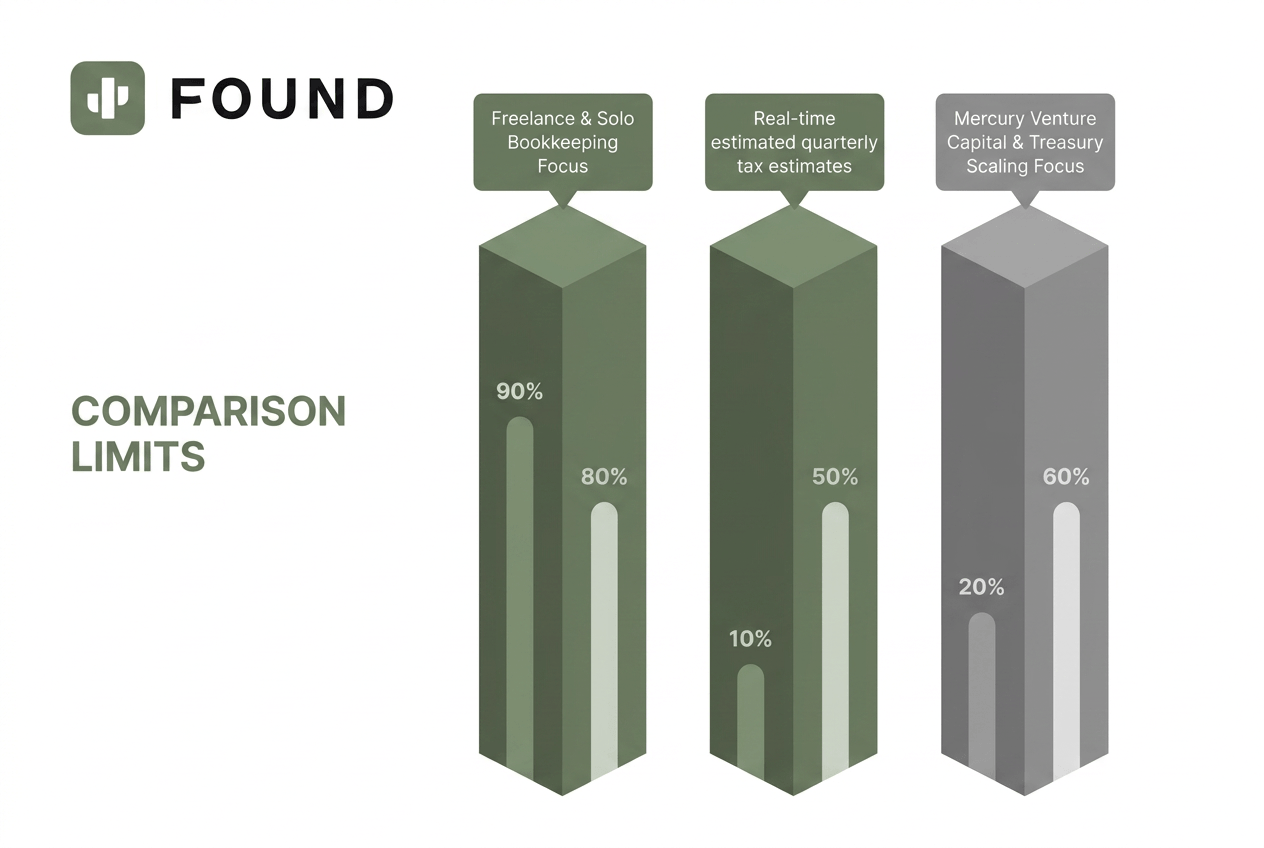
Both target independent business owners, but the overlap ends pretty quickly once you look closer.
| Comparison Criteria | Found | Mercury |
|---|---|---|
| Business Banking Features | Checking account plus built-in bookkeeping | Checking, savings, and treasury products |
| Financial Management Tools | Invoicing, tax estimation, expense tracking | Bill pay, team spend controls, integrations |
| Pricing | Free core, $35 to $80 monthly for add-ons | No monthly fees on any tier |
| Best Business Type | Solo freelancers and independent contractors | Startups and venture-backed companies |
So is Found better than Mercury? Depends entirely on what kind of business you’re running. Solo freelancer wanting taxes handled automatically, Found wins that comparison easily. Startup planning to raise capital or scale a team, Mercury’s built for that specifically and Found just isn’t.
Is Found Worth It?
For freelancers and sole proprietors, yes, Found worth it comes down to how much you value having banking and bookkeeping under one login. The automated tax tools alone can save real accounting costs over a year. Scaling past a solo operation though? Worth stopping to check whether Found’s feature set still keeps up once you’re adding headcount.
Frequently Asked Questions
Is Found good for freelancers?
Yes, it’s built specifically around freelance and sole proprietor needs, with banking and tax tools combined in one account.
Does Found charge monthly fees?
The core account has no monthly fee. Optional Found Plus and Found Pro tiers add advanced features starting at $35 a month.
Does Found pay interest?
Only on paid plans, up to 2.50% APY. The free plan does not earn APY. Found Plus costs $35 a month or $315 a year and earns 1.50% APY on balances up to $20,000. Found Pro earns 2.50% APY with no balance cap.
Can Found replace QuickBooks?
For basic expense tracking and invoicing, often yes. For complex accounting needs, Found’s integration options stay fairly limited.
Is Found FDIC insured?
Yes, through its banking partner Lead Bank, with coverage up to $250,000 per depositor per ownership category.
Is Found better than Mercury?
For solo freelancers, generally yes. For startups needing treasury tools or team banking, Mercury is the stronger fit.
Final Verdict
Found makes sense, real sense, for freelancers and independent contractors who want banking, invoicing, and tax estimation without stitching five different tools together. Automation’s where it excels. The tax and bookkeeping features save time most solo business owners would otherwise spend somewhere else entirely.
Traditional business banks, or a platform like Mercury, probably serve better once a company starts adding employees or needs deeper financial infrastructure than one app can offer. Overall though, Found delivers strong value for exactly who it’s built for. B2BMoneyGuides recommends it for freelancers and solo consultants running their business finances on their own.
Explore Found's Official Website