At a Glance
- US stocks and ETFs: $0 commission, fractional shares from $10
- Options: $0 commission on equity options in the US
- Crypto: 1% fee on each buy and sell, added to the market price
- Withdrawal: $5 flat on USD accounts, $30 minimum; free on GBP and EUR accounts
- Inactivity: $10 a month after 12 months without a login
- CopyTrader: free to use, $200 minimum per copied trader
- Regulation: FINRA and SIPC member in the US; parent listed on Nasdaq as ETOR since May 2025
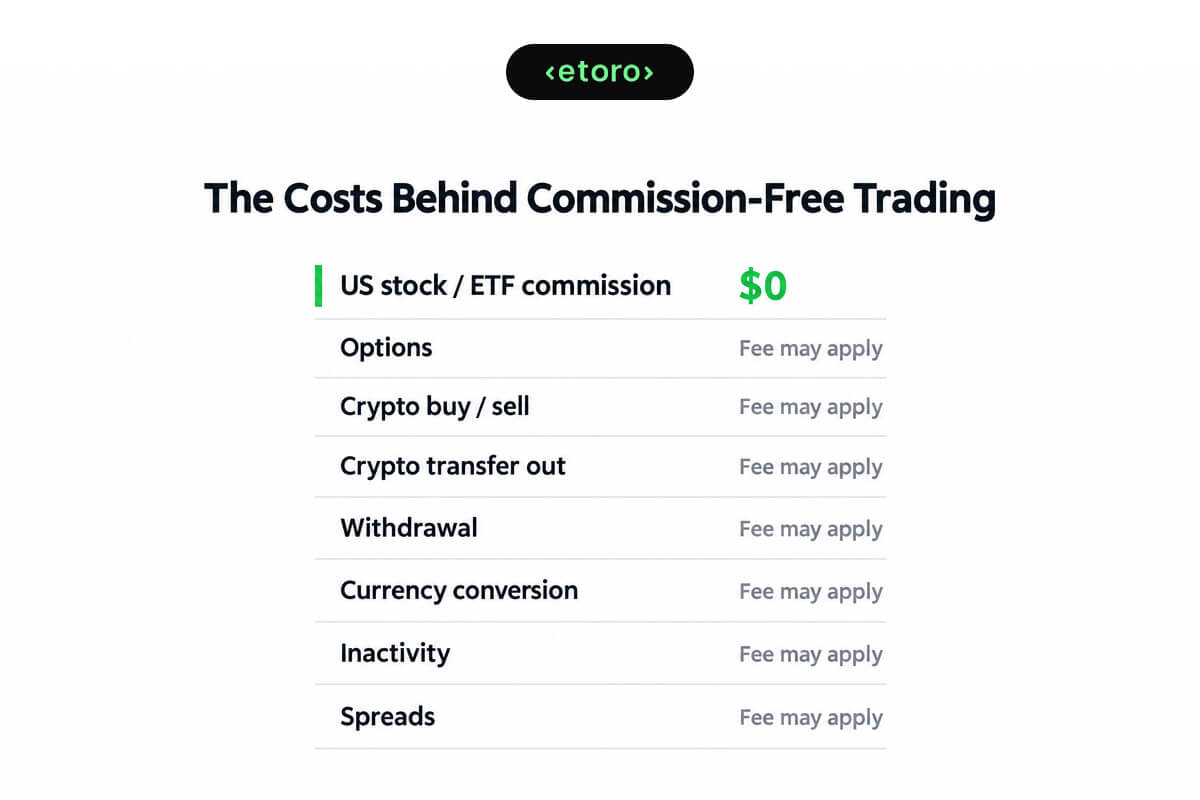
Every broker with a “commission-free” banner has a fee somewhere. That’s how the business works. With eToro the fees sit in crypto, currency conversion, withdrawals, and inactivity. None is large alone. Together they decide whether the platform is cheap or only cheap-looking for the way you invest.
Identify: What eToro Actually Is
eToro started in Israel in 2007 as a social trading platform. The idea: see what other investors are doing and, if you like, copy them automatically. It now claims more than 35 million registered users, and the parent went public on Nasdaq in May 2025.
In the US, eToro USA Securities handles stocks, ETFs, and options, and eToro USA LLC handles crypto. Cash sits in FDIC-insured partner banks. It doesn’t offer Americans CFDs, the leveraged products it sells in Europe, or retirement and joint accounts. Crypto is unavailable in Nevada, Hawaii, Puerto Rico, and the Virgin Islands.
For a US reader, then, eToro is a taxable brokerage with stocks, ETFs, options, crypto, a $100,000 demo account, and the copy feature on top.
Evaluate: The eToro Fee Stack, Line by Line
| Fee | Amount | When It Bites |
|---|---|---|
| Stock and ETF commission | $0 on US exchanges | Never, apart from small regulatory fees on sales |
| Non-US stocks | Up to $2 per trade | Buying foreign listings |
| Options | $0 commission | Standard exchange fees still apply |
| Crypto | 1% per buy, 1% per sell | Every crypto trade, both ways |
| Crypto transfer out | Around 2% | Moving coins to your own wallet |
| Withdrawal | $5 flat, $30 minimum | Every withdrawal from a USD account |
| Currency conversion | 0.75% to 1% | Depositing or withdrawing in non-USD currency |
| Inactivity | $10 a month | After 12 months with no login |
| Spreads | Variable | Mostly a crypto and forex issue, not stocks |
Now the table applied to two people.
A buy-and-hold ETF investor puts in $500 a month, buys a couple of index ETFs, never touches crypto, and withdraws once a year. Annual cost: about $5. The withdrawal fee. That’s it. This is where eToro is genuinely cheap.
A crypto-curious trader moves $10,000 into Bitcoin and Ether over a year, sells about half, and withdraws twice. Annual cost: $100 to buy, $50 to sell, $10 in withdrawals, roughly $160 before spreads. Coinbase’s advanced tier and Kraken are cheaper for that behavior. The 1% flat rate is simple. Simple is not the same as low.
The inactivity fee is the one people forget. Log in once a year and it never applies.
CopyTrader and Smart Portfolios, Priced Honestly
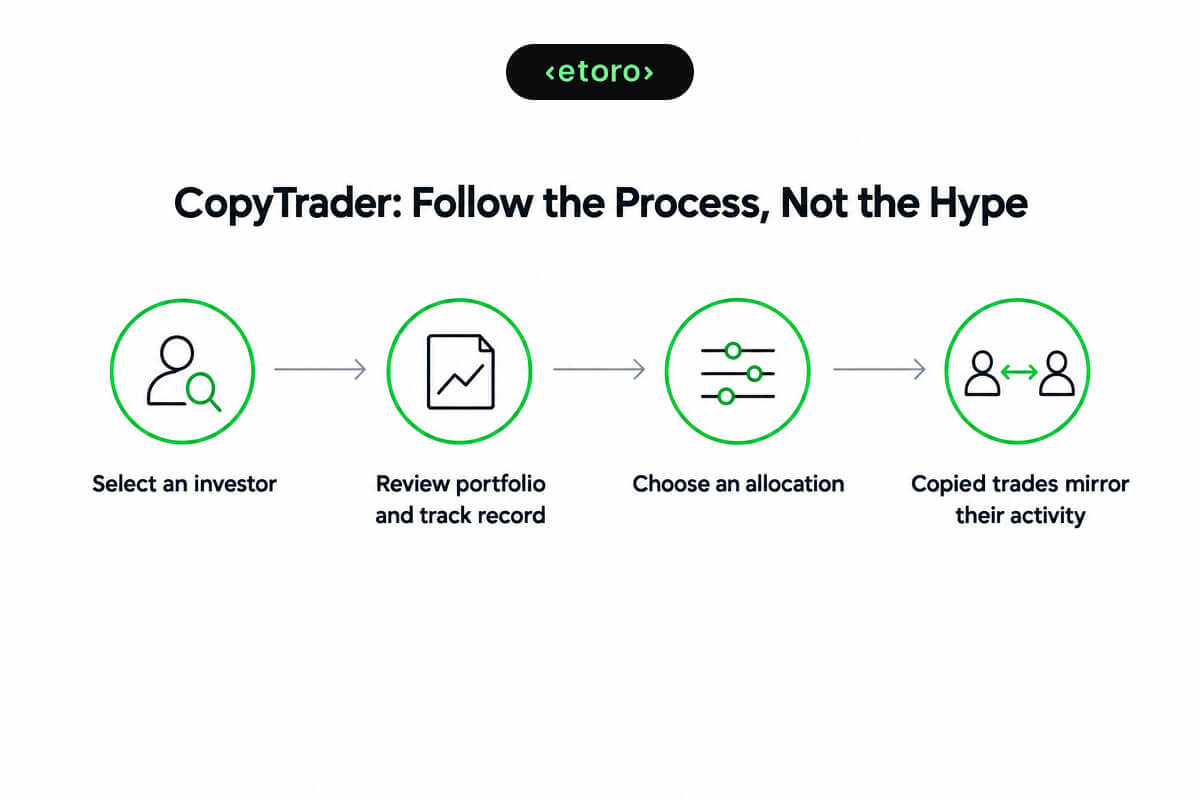
CopyTrader costs nothing extra. Pick an investor, allocate $200 or more, and your account mirrors their trades in proportion. You pay the normal trading fees on whatever they buy. Smart Portfolios are themed baskets built by eToro; no management fee, just the underlying spreads.
What it costs you is judgment. A copied trader’s past year is not a forecast, and leaderboards reward recent returns, which tempts people into copying someone at the top of a hot streak. Read the profile like a fund factsheet: drawdown and track record, not the headline percentage.
Compare: eToro vs. Robinhood vs. Fidelity vs. Coinbase
| Parameter | eToro | Robinhood | Fidelity | Coinbase |
|---|---|---|---|---|
| US stocks and ETFs | $0 | $0 | $0 | Not offered |
| Crypto fee | 1% each way | Spread, roughly 0.5% to 1% | Limited crypto | 0.5% to 1.5% simple, lower on advanced |
| Withdrawal fee | $5 | $0 | $0 | Varies |
| Inactivity fee | $10 a month after a year | None | None | None |
| Retirement accounts | No | Yes | Yes | No |
| Copy trading | Yes | No | No | No |
| Interest on idle cash | Up to 3.25% in options accounts | Yes, with Gold | Yes | No |
| Best for | Social investors, copy trading | Casual traders | Long-term investors | Crypto focus |
On cost, Fidelity is cheaper for a long-term investor: no withdrawal or inactivity fees, and it offers an IRA. Coinbase’s advanced tier is cheaper for crypto. Robinhood matches eToro on stocks and beats it on withdrawals.
eToro wins on the copy feature, the community, and a cleaner interface. If those matter, the $5 withdrawal and the 1% crypto fee are the price of admission. If they don’t, another broker costs less over five years.
Recommend: Before You Fund the Account
- Decide what the account is for. ETFs and stocks only, and eToro is cheap. Crypto-heavy, and it isn’t.
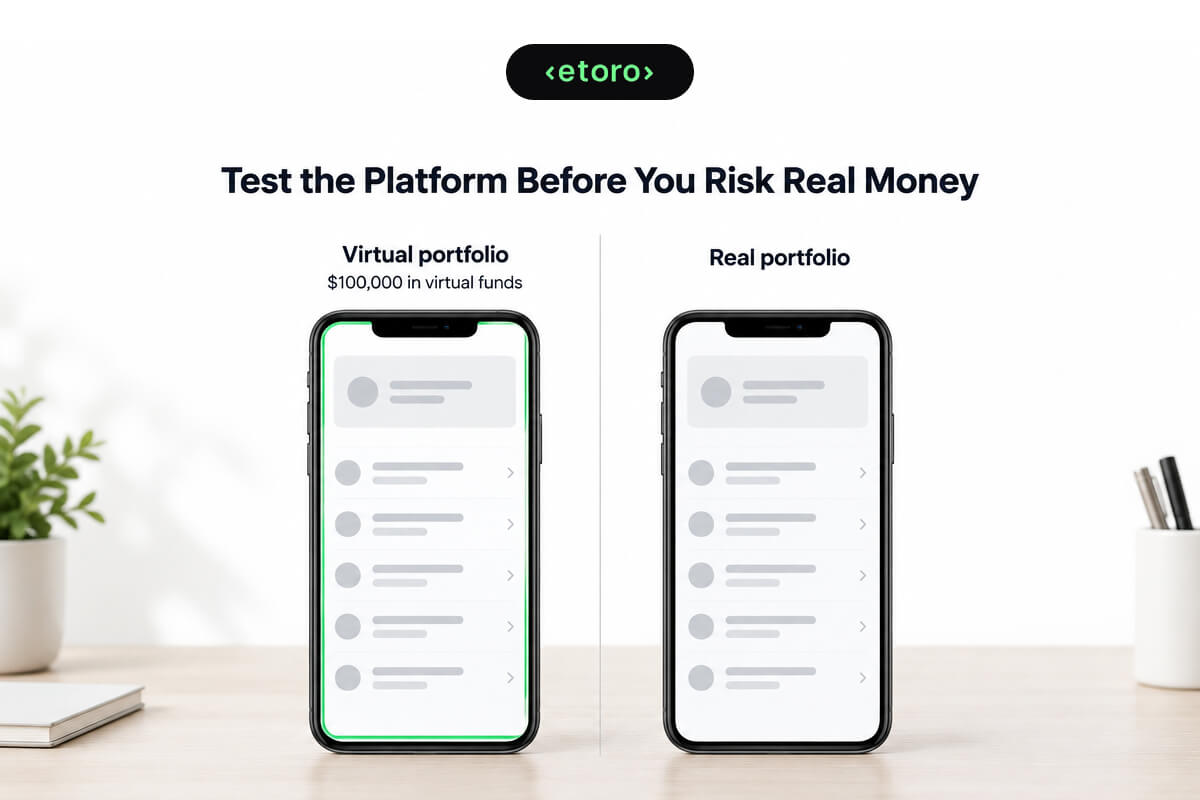
- Use the demo first. $100,000 in virtual money, same interface. Learn the order ticket before real dollars go in.
- Check the estimated cost on every trade. The trade ticket shows it. Crypto and non-US stocks are where the number surprises people.
- Batch your withdrawals. $5 each, so one a year beats twelve.
- Log in at least once a year. The inactivity fee is avoidable and annoying.
- Set a cap on copy allocations. A percentage of the account, not a number you’d miss.
- Keep retirement money elsewhere. No IRA here, so taxable investing only.
- Read the state list of crypto matters. Four states and territories are excluded.
Who eToro Is Actually For
Good fit: newer investors who want to see what other people are doing before they act, people who like a single app for stocks, options, and crypto, and anyone who values a clean interface over the lowest possible fee. The ETF investor in the example above pays $5 a year. That’s a fair deal.
Poor fit: active crypto traders, who will pay more here than on a dedicated exchange; anyone building retirement savings, since there’s no IRA; and investors who withdraw often or go quiet for a year at a time.
Borderline: small business owners parking short-term cash. The interest on idle cash in options accounts is competitive, but it’s a brokerage, not a savings account, and the withdrawal fee adds friction. A high-yield savings account is usually simpler.
A word on risk. Stocks and ETFs go down as well as up. Crypto goes down faster. Copying another investor doesn’t remove either; it outsources the decision. Only invest what you can leave alone for years.
Frequently Asked Questions
Is eToro free to use?
US stocks, ETFs, and options carry no commission. Crypto costs 1% each way, withdrawals $5, and inactivity $10 a month after a year without a login.
Is eToro safe?
In the US it’s a FINRA and SIPC member, cash sits in FDIC-insured banks, and the parent company is listed on Nasdaq.
Does CopyTrader cost extra?
No. You pay normal trading fees on what the copied investor buys. Minimum $200 per trader.
Can I open an IRA?
No. eToro offers taxable individual accounts only in the US.
What’s the minimum deposit?
$10 for US crypto accounts, and fractional shares start at $10.
Final Verdict
eToro is a well-built, well-regulated platform with one distinctive feature and a fee structure that is cheap for some habits and not for others. Buy-and-hold investors will barely notice the fees. Crypto traders and frequent withdrawers will. Run your own year through the fee table, compare it with Fidelity or Coinbase, and open the account only if the copy features are worth the difference. Five minutes of arithmetic.