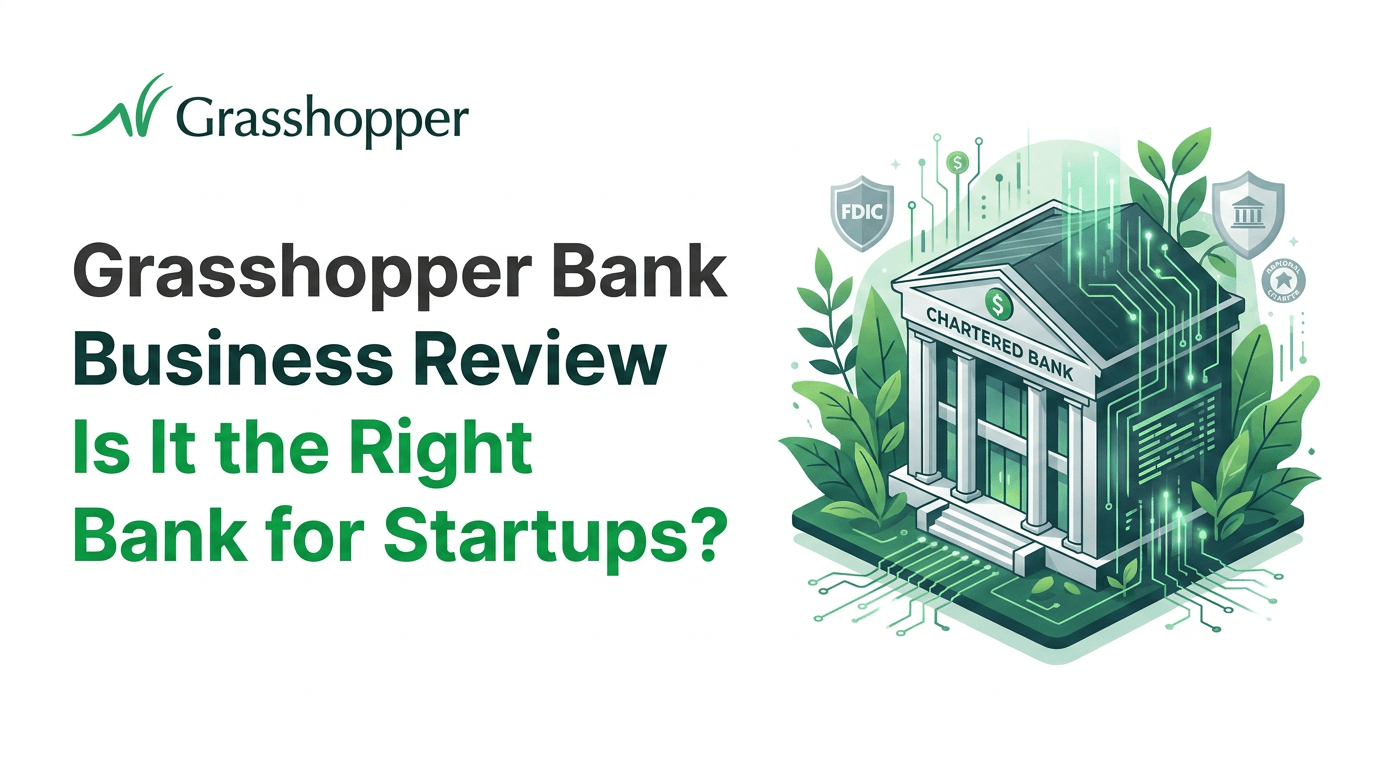
Most digital-first business banks are fintechs leaning on a partner bank behind the scenes. Grasshopper Bank is different: it holds its own national bank charter, built specifically for startups, small businesses, and venture capital and private equity firms. That charter comes with real lending capability, SBA loans, commercial real estate, and venture banking that most app-based competitors can’t offer. It’s also in the middle of a major ownership change that’s worth understanding before you sign up. This review covers the accounts, the fees, and what’s actually happening with the business.
Open a Grasshopper Bank Business Account
Key Benefits of Grasshopper Bank
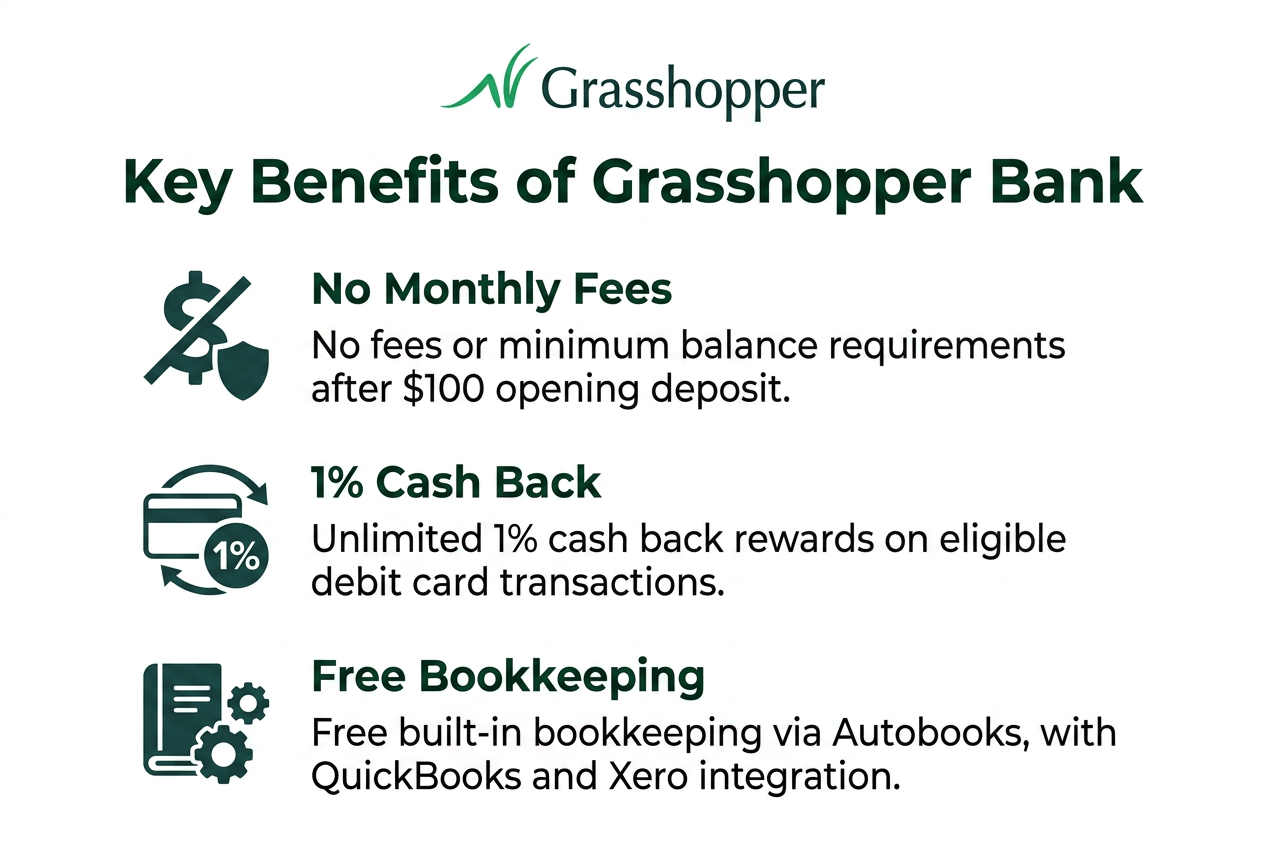
- No monthly fees or minimum balance requirements following the $100 initial deposit
- Unlimited 1% cashback rewards on eligible debit card transactions
- Increased FDIC insurance protection for $125 million via a sweep program
- SBA preferred lender status, plus commercial real estate and VC/PE lending
- Free built-in bookkeeping through Autobooks, with QuickBooks and Xero integration
About Grasshopper Bank
Company Overview
Grasshopper Bank was founded in 2019 with a de novo national banking charter from the Office of the Comptroller of the Currency, a rare feat for digital banks since many of them lease a charter from a partner bank. Operating from New York, the bank is led by its CEO Mike Butler, who has experience starting Radius Bank before it got acquired by LendingClub in 2020. By the end of 2025, Grasshopper Bank had approximately $1.6 billion worth of assets, which grew by 83% from the previous year, and almost $3 billion worth of deposits.
Who It’s Built For
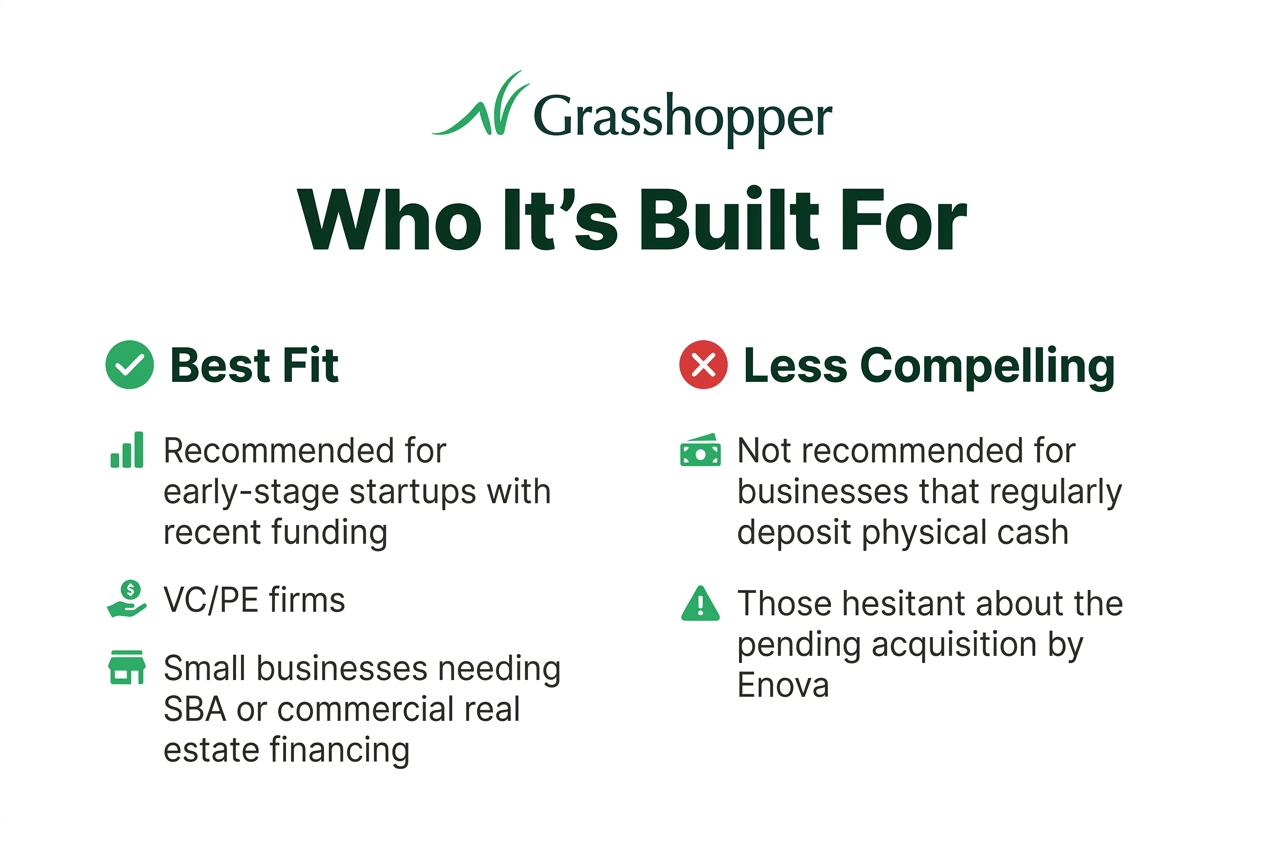
Grasshopper targets the startup and innovation economy: early-stage companies that just raised a funding round, venture capital and private equity firms managing fund operations, and small businesses wanting SBA or commercial real estate financing from the same bank holding their checking account.
Checking, Savings & Rates
Innovator Business Checking charges no monthly fee and requires only a $100 opening deposit, with tiered interest and cash back layered on top.
| Account | Monthly Fee | APY |
|---|---|---|
| Innovator Business Checking | None; $100 minimum to open | 1.00% up to $24,999 and above $250,000; 1.35% on $25,000–$250,000 |
| Business Savings / MMA bundle | None | Up to roughly 3.00% on qualifying balances |
| Accelerator Savings | None | Tiered, up to 3.00% on balances of $25,000 or more |
Compare Grasshopper Bank Account Options
Lending & Venture Banking
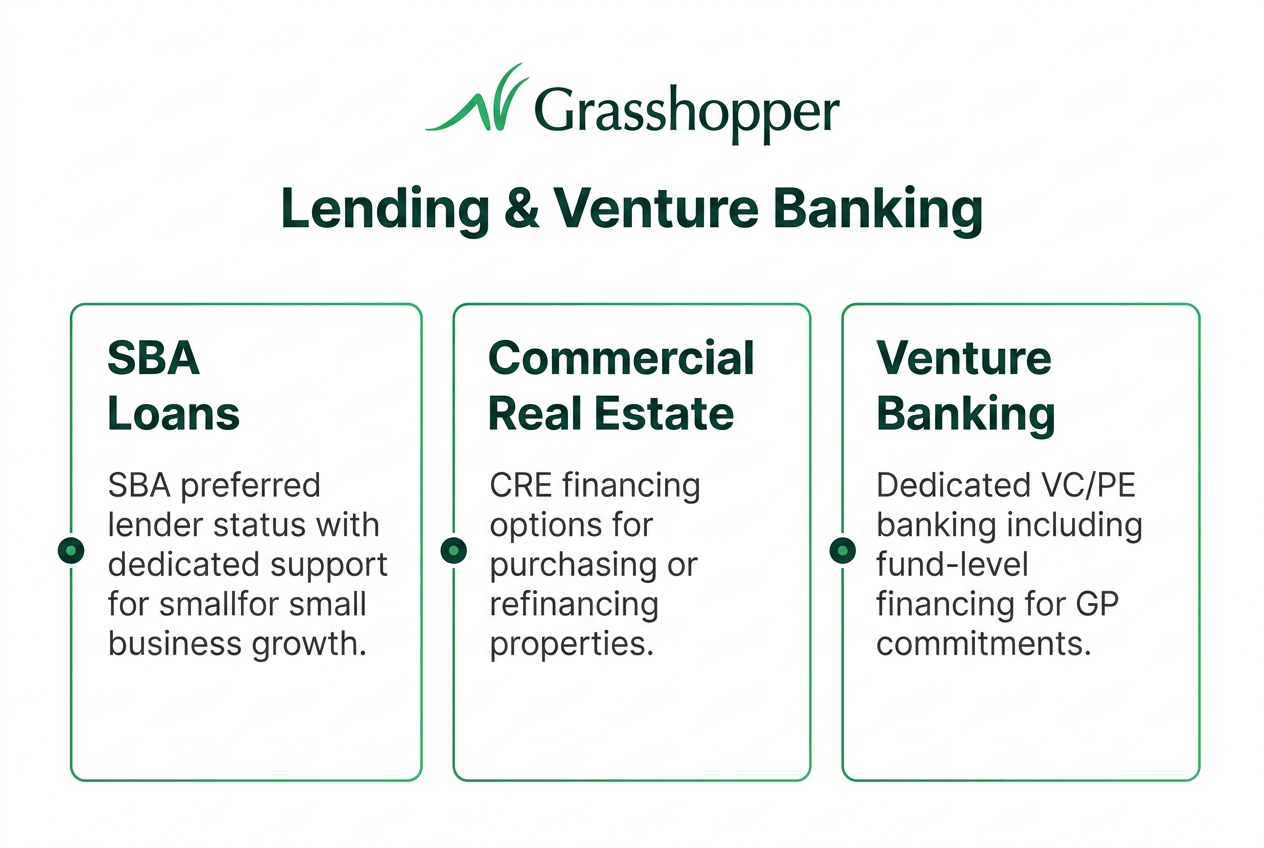
This is where Grasshopper separates itself from fintech-only competitors. As an SBA preferred lender, it offers SBA loans alongside commercial real estate financing and dedicated venture capital and private equity banking, including fund-level financing for GP commitments, a real lending path without switching banks as a startup grows.
Enhanced FDIC Insurance
Standard FDIC coverage caps out at $250,000 per depositor, thin protection for a startup sitting on a large funding round. Grasshopper’s optional Insured Cash Sweep program distributes deposits across a network of partner banks, extending coverage up to $125 million. The program carries its own terms and added requirements, worth confirming directly with Grasshopper if a large balance is your main reason for considering the bank.
A Pending Ownership Change Worth Knowing About
In December 2025, Enova International announced the signing of a definitive agreement to purchase Grasshopper Bancorp for around $369 million in cash and stock. The transaction needs approval from the OCC, the Federal Reserve, and shareholders and is planned to close by the second half of 2026. After the completion of the acquisition, Grasshopper Bank will become a bank subsidiary of Enova, and its CEO Michael Butler will switch to a position of president. Meanwhile, Grasshopper’s operation will proceed as usual under its own charter and FDIC insurance, but clients with considerable balances might consider keeping an eye on the process.
Customer Support & Reputation
Grasshopper’s mobile app rates are around 4.5 on the App Store and 4.2 on Google Play. Grasshopper receives polarized reviews on Trustpilot — around 68% of accounts have a five-star rating while around 23% of users rate Grasshopper with just one star due to some issues with account approval and servicing.
Pros and Cons
| Pros | Cons |
|---|---|
| No monthly fees or minimum balance after the $100 opening deposit | No cash deposit support; digital-only with no branches |
| Unlimited 1% cash back on qualifying debit card purchases | Trustpilot reviews are polarized: 68% five-star, 23% one-star |
| Enhanced FDIC insurance up to $125 million through a sweep network | Enhanced FDIC coverage is optional and comes with added requirements |
| SBA preferred lender status plus commercial real estate and VC/PE lending | Pending acquisition by Enova adds uncertainty about the bank’s future ownership |
| Built for the venture and startup ecosystem, not just generic small business |
Grasshopper Bank vs Mercury
Mercury is the other name that comes up constantly in startup banking searches, and the two take meaningfully different structural approaches.
| Factor | Grasshopper Bank | Mercury |
|---|---|---|
| Type of institution | Directly chartered national bank, FDIC-insured | Fintech; banking via partner banks |
| Checking APY | Up to 1.35%, plus 1% cash back on debit purchases | No standard checking APY |
| Extended FDIC coverage | Up to $125 million via sweep network | Up to $5 million via partner bank sweep |
| SBA & commercial lending | Yes, SBA preferred lender plus CRE and VC/PE lending | Not offered directly |
| Ownership status | Pending acquisition by Enova International (2026) | Independently operated |
| Best for | Startups wanting a real bank charter with lending options | Startups wanting a fintech-style dashboard and API access |
Is Grasshopper Bank Worth It?
Worth it if you want fee-free checking with real yield, may need SBA or venture-stage financing down the line, or are holding a large balance that benefits from the extended FDIC coverage. Less compelling if you regularly deposit cash, or if the pending Enova acquisition makes you hesitate.
Frequently Asked Questions
Is Grasshopper Bank FDIC insured?
Yes, up to $250,000, or up to $125 million using their optional sweep network.
Does Grasshopper Bank offer SBA loans?
Yes, as an SBA preferred lender, plus commercial real estate and VC/PE financing.
Can I deposit cash with Grasshopper Bank?
No, this digital bank does not accept cash deposits.
Is Grasshopper Bank better than Mercury?
It depends: Grasshopper provides a direct bank charter and lending, whereas Mercury offers a fintech dashboard.
Final Verdict
Grasshopper Bank stands out from most digital business banks by actually holding its own charter, backing that up with real lending, SBA, commercial real estate, and venture banking that few app-based competitors can match. Fee-free checking with a real yield and extended FDIC coverage make it a genuinely strong fit for the startup audience it targets.
The pending Enova acquisition is the one open question worth tracking, not a reason to avoid the bank today, but a detail worth watching if you’re planning to keep a large balance there long-term. For startups and venture-backed companies that want banking and lending under one roof, Grasshopper remains a solid choice heading into its next chapter.
Apply for Grasshopper Bank Business Banking