
Wireless bills creep up fast once you’re paying for a whole team, and most business carrier plans come loaded with features a five-person shop will never touch. Total Wireless runs on Verizon’s actual network but prices itself like a budget prepaid brand, no contracts, no credit check.
Can that combination actually cut communication costs for freelancers and small businesses without leaving them stuck on flaky service? That’s the real question this review works through, pricing, coverage, and where the cracks show up once a business tries to lean on it full time.
Why Businesses Consider Total Wireless
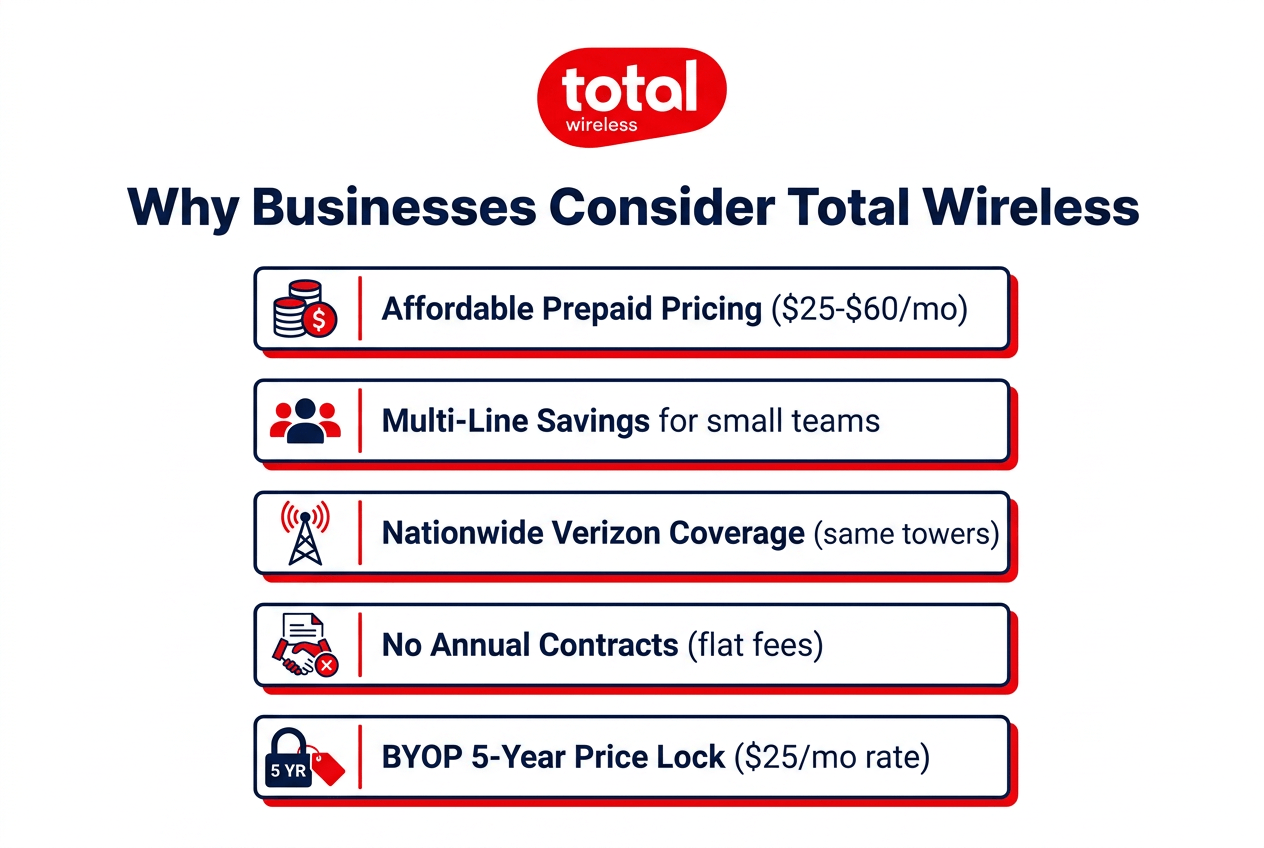
- Affordable prepaid pricing
- Multi-line savings
- Nationwide Verizon coverage
- No annual contracts
- Flexible BYOP support
About Total Wireless
Company Overview
Total Wireless operates as a prepaid brand under Verizon, folded in through Verizon’s acquisition of TracFone and now running as a first-party Verizon service rather than a separate reseller. That matters more than it sounds, it means the towers, the network, the coverage map, all of it is the exact same infrastructure Verizon’s postpaid customers use. The pricing model though stays firmly prepaid, taxes and fees baked into the sticker price, no surprise line items later.
Who Total Wireless Is Best For
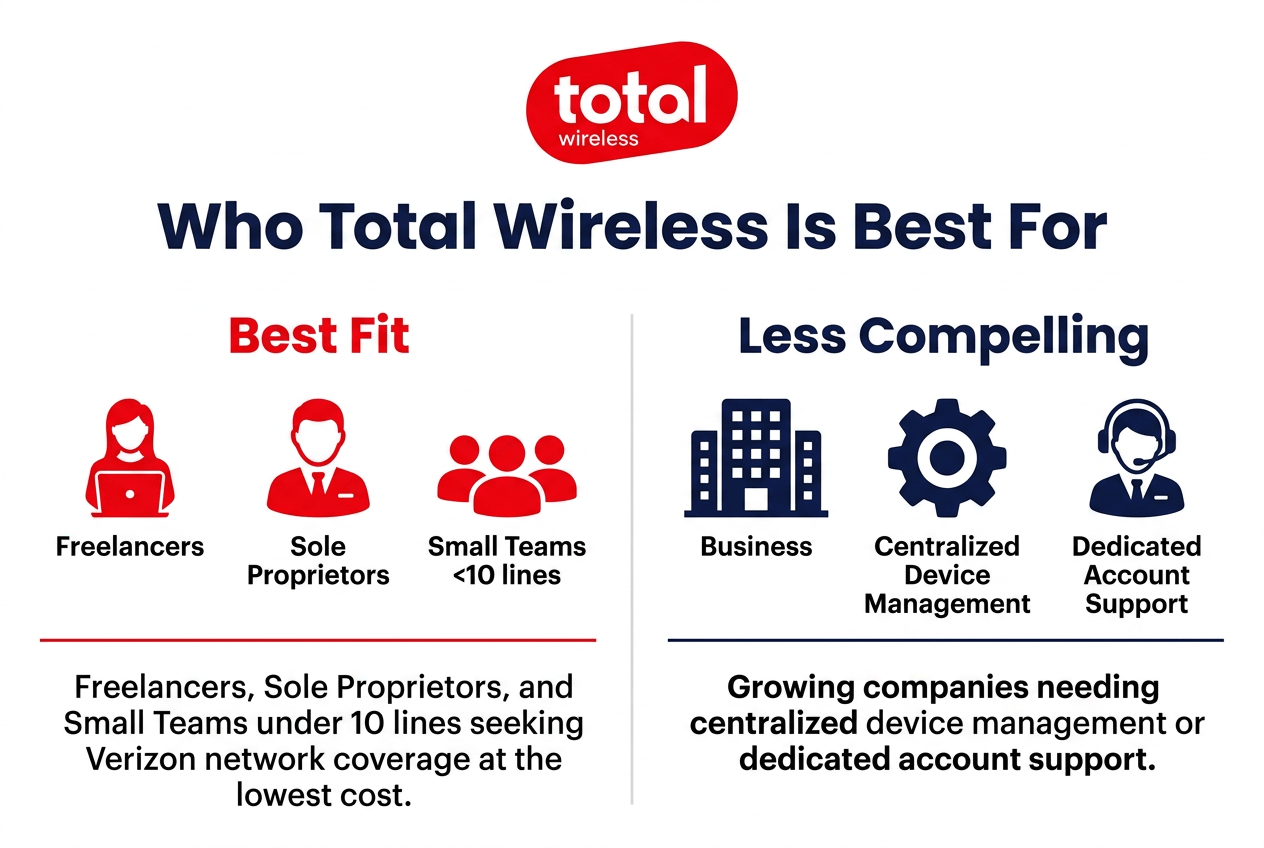
Freelancers, remote consultants, sole proprietors, small teams under maybe ten people, that’s really the sweet spot here. Anyone whose main priority is a reliable phone bill that doesn’t creep up every renewal cycle.
Plans & Business Communication Solutions
Unlimited Wireless Plans
Four tiers currently run the lineup. Total STARTER sits at $35 a month. Bringing your own device? Total MAX 5G BYO drops that down to $25. Total MAX 5G runs $50 without BYOP. Then there’s Total ALL ACCESS, tops out at $60, and that one throws in faster hotspot speeds plus a Disney+ Premium subscription for as long as you stay on it.
Multi-Line Plans
Adding lines brings the per-line cost down noticeably, a small team running three or four phones on one account ends up paying meaningfully less per line than starting fresh on separate individual plans elsewhere.
Bring Your Own Phone (BYOP)
BYOP is where the real savings show up. Bringing a compatible device unlocks the $25 rate, and new BYOD customers also get a five-year price lock, meaning that rate holds steady for five full years regardless of future price changes.
Home Internet & Mobile Hotspot
Home internet and mobile hotspot options extend the same Verizon backbone to a home office setup, useful for remote workers who need connectivity beyond just a phone plan, though speeds and caps vary depending on which tier you’re on.
Business Value Beyond Low Pricing
Managing Communication Expenses
Predictable flat pricing makes budgeting simpler for a small operation, no usage-based surprises eating into a tight monthly forecast the way some carriers still structure billing.
Multi-Line Savings for Small Teams
For a business running two or three employees on company phones, bundling lines under one account cuts real cost compared to managing separate personal plans and reimbursing each one manually.
Supporting Mobile & Remote Work
Roaming across Canada and Mexico comes standard on most tiers, plus international calling to dozens of destinations, genuinely useful for a consultant or freelancer working with clients outside the US regularly.
Where Total Wireless Falls Short for Growing Businesses
Once a company grows past a handful of employees though, the lack of centralized account management becomes a real problem. There’s no dashboard built for adding or removing lines at scale, no dedicated business support line, just the same consumer app everyone else uses.
Coverage, Reliability & Customer Experience
Verizon Network Coverage
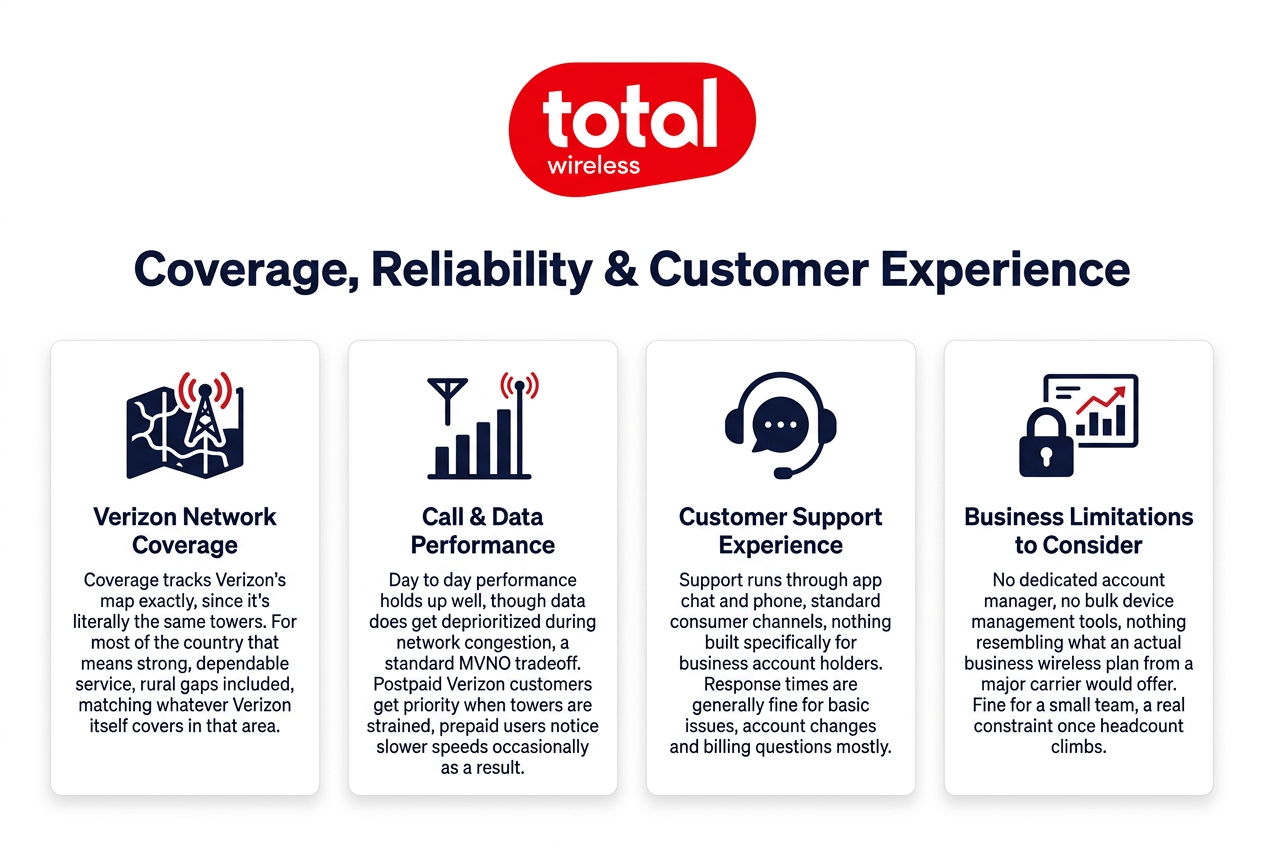
Coverage tracks Verizon’s map exactly, since it’s literally the same towers. For most of the country that means strong, dependable service, rural gaps included, matching whatever Verizon itself covers in that area.
Call & Data Performance
Day to day performance holds up well, though data does get deprioritized during network congestion, a standard MVNO tradeoff. Postpaid Verizon customers get priority when towers are strained, prepaid users notice slower speeds occasionally as a result.
Customer Support Experience
Support runs through app chat and phone, standard consumer channels, nothing built specifically for business account holders. Response times are generally fine for basic issues, account changes and billing questions mostly.
Business Limitations to Consider
No dedicated account manager, no bulk device management tools, nothing resembling what an actual business wireless plan from a major carrier would offer. Fine for a small team, a real constraint once headcount climbs.
Pros and Cons
Real trade-offs worth understanding before switching a whole team over.
| Pros | Cons |
|---|---|
| Affordable prepaid pricing | No dedicated business support |
| Verizon nationwide network | Limited enterprise management tools |
| Multi-line savings | Consumer-focused service model |
| No contracts and BYOP flexibility | Less suitable for larger organizations |
Total Wireless vs Verizon Business
Both run on the same network, but the business infrastructure around that network couldn’t be more different.
| Factor | Total Wireless | Verizon Business |
|---|---|---|
| Monthly Cost | $25 to $60 per line, prepaid | Higher, postpaid, contract-based pricing |
| Network Coverage | Full Verizon network access | Full Verizon network access, priority during congestion |
| Business Features | None, consumer app only | Account management, device provisioning tools |
| Account Management | Self-service, individual lines | Centralized dashboard for teams |
| Scalability | Workable for small teams | Built for growing and large organizations |
| Best For | Freelancers, sole proprietors, tiny teams | Companies needing real business infrastructure |
So which one actually fits better? Depends entirely on team size honestly. A freelancer or a two-person shop watching every dollar, Total Wireless wins on price without much of a downside. A company planning to add headcount and needing real account controls, Verizon Business earns its higher cost pretty quickly at that point.
Is Total Wireless Worth It?
For solo operators and small teams focused on cutting costs, yes. Worth it, especially once you pair BYOP with that five-year price lock. Planning to scale past a handful of employees though? Worth thinking ahead on that one. Centralized management tools just aren’t here, and that gap turns into a real friction point eventually, so it’s better to plan around it now than get caught off guard later.
Frequently Asked Questions
Is Total Wireless good for small businesses?
Yes, particularly teams under ten people focused on cost control rather than centralized account management tools.
Does Total Wireless use Verizon’s network?
Yes, directly. Total Wireless runs on the same towers and coverage footprint as Verizon’s own postpaid service.
Can businesses bring their own phones to Total Wireless?
Yes, and it’s actually the cheapest path in, $25 a month with a five-year price lock for compatible devices.
How does Total Wireless compare with Verizon Business?
Total Wireless costs less but skips business account tools entirely. Verizon Business costs more but adds real management infrastructure for teams.
Is Total Wireless Home Internet suitable for remote work?
For basic connectivity, yes. For heavy, mission-critical remote work needs, it’s worth comparing speeds against dedicated business internet first.
Final Verdict
Total Wireless makes sense for freelancers, sole proprietors, and small teams who want Verizon’s network without Verizon’s business pricing attached to it. Where it really delivers is flat, predictable costs and genuine BYOP flexibility, especially with that five-year price lock sweetening the deal.
Growing businesses needing centralized account management or dedicated support should look toward Verizon Business or a similar provider instead, since that infrastructure gap is real. Overall, B2BMoneyGuides recommends Total Wireless specifically for cost-conscious solo operators and small teams who don’t need enterprise tools attached to their phone bill.
Visit Total Wireless's Official Website